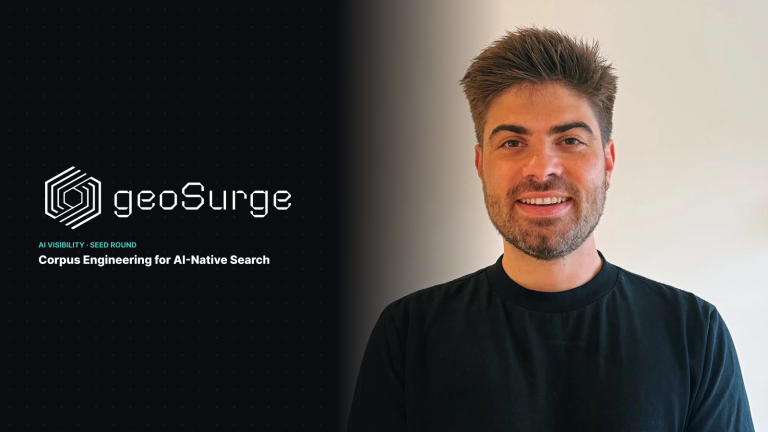
geoSurge, a London-based AI visibility startup, has raised a $12 million Seed round led by AlbionVC, with participation from Play Ventures, Octopus Ventures, Celero Ventures, Boost Capital, existing investors Passion Capital and Tuesday Capital, and angel investors from Google DeepMind, Microsoft AI, and Signal AI. The company is building around a simple but increasingly important question for brands: what happens when customers stop searching through links and start asking AI systems for answers?
The funding is not just another bet on marketing software. The signal is that AI visibility is becoming a new layer of brand infrastructure. For years, companies optimized for search engines, social feeds, review platforms, and marketplaces. Now the discovery surface is shifting again, this time toward generative AI systems such as ChatGPT, Gemini, and Claude. geoSurge’s thesis is that brands will need to understand not only whether they are cited by AI tools, but how those systems internally understand and represent them.
What geoSurge does
geoSurge helps organizations monitor and improve how they appear inside generative AI answers. Its platform covers visibility across systems including ChatGPT, Claude, and Gemini, while also tracking competitors, sources, trends, and brand mentions. The company’s enterprise product goes deeper, offering features around probabilities, token-level signals, AI traffic classification, crawling, rephrasing, and Corpus Engineering.
The company describes Corpus Engineering as a discipline focused on how large language models learn, store, and surface brand information. In practical terms, geoSurge is positioning itself against the idea that AI visibility is only about tracking prompts or citations. Its argument is that the harder problem is model representation: whether AI systems have accurate, stable, and useful knowledge about a company before they generate an answer.
That distinction matters because AI-generated answers do not behave like traditional search results. A brand may rank well on Google and still fail to appear in a chatbot response. A company may be cited in one prompt, ignored in another, or represented inaccurately when a model version changes. geoSurge’s work sits in that gap between classic SEO, generative engine optimization, brand intelligence, and enterprise AI monitoring.
The funding details
The $12 million Seed round was led by AlbionVC. Other investors include Play Ventures, Octopus Ventures, Celero Ventures, Boost Capital Partners, Passion Capital, Tuesday Capital, and angels from Google DeepMind, Microsoft AI, and Signal AI. UKTN reported the round at £9.4 million, while EU-Startups reported it as €10 million, reflecting currency conversion of the same $12 million round.
geoSurge plans to use the funding to grow its global research and engineering teams, invest in AI infrastructure and compute capacity, and accelerate development of its Corpus Engineering discipline. The company says it already works with customers across four continents and industries including financial services, education, and hospitality. Since emerging from stealth in 2025, its headcount has doubled, with 80% of employees specializing in AI and data science.
Why this matters now
The commercial question is no longer only whether a company appears on page one of Google. It is whether AI systems mention the company at all, describe it correctly, compare it fairly, and include it when users ask for recommendations.
That changes the visibility economy. In search, the user sees links. In social, the user sees posts. In AI search, the user may see a synthesized answer with only a few cited sources, or no traditional browsing journey at all. This creates a new pressure point for enterprises: if buyers use AI systems to shortlist vendors, research tools, compare products, or decide where to spend money, model representation becomes a business risk.
geoSurge’s approach is built around the belief that prompt-level analytics and citation tracking may become commoditized. The company is betting that the more defensible layer is understanding how models learn and remember brand information. Its official site describes enterprise work at the level of model probabilities and token-level visibility, not just surface ranking.
The market signal
The bigger shift is that AI visibility is becoming its own category. Early versions of the market focused on generative engine optimization, prompt tracking, and citation monitoring. Those tools answer an important question: “Did the model mention us?” geoSurge is trying to answer a deeper one: “Why does the model understand us this way, and how can that representation become more accurate over time?”
That could matter most for companies in complex, high-consideration markets: enterprise software, financial services, healthcare, travel, education, cybersecurity, and B2B infrastructure. These are categories where buyers often research before purchasing, compare multiple vendors, and rely on trusted explanations. If generative AI becomes part of that workflow, brand memory inside models becomes part of go-to-market strategy.
There is also a risk. The category is early, terminology is still unsettled, and platforms such as OpenAI, Google, Anthropic, and Perplexity will keep changing how answers are generated, retrieved, cited, and personalized. Companies buying AI visibility tools will need to separate measurable insight from speculative optimization. The useful vendors will be the ones that can show evidence, methodology, and repeatable outcomes without promising control over systems they do not own.
What to watch next
The next layer is proof. geoSurge has funding, a strong category narrative, and technical positioning around Corpus Engineering. What investors, enterprises, and competitors will watch next is whether the company can turn that thesis into measurable commercial outcomes.
Key questions remain: Can AI visibility be tied to pipeline, conversions, or brand preference? Will enterprises treat AI representation as a marketing function, a data function, or a risk function? Will model providers expose more visibility and attribution data over time, or will third-party tools need to infer it from outside?
For now, geoSurge’s Seed round points to a broader market reality: AI discovery is no longer a future concern. It is becoming a live operating question for brands that depend on being found, understood, and trusted in machine-generated answers.