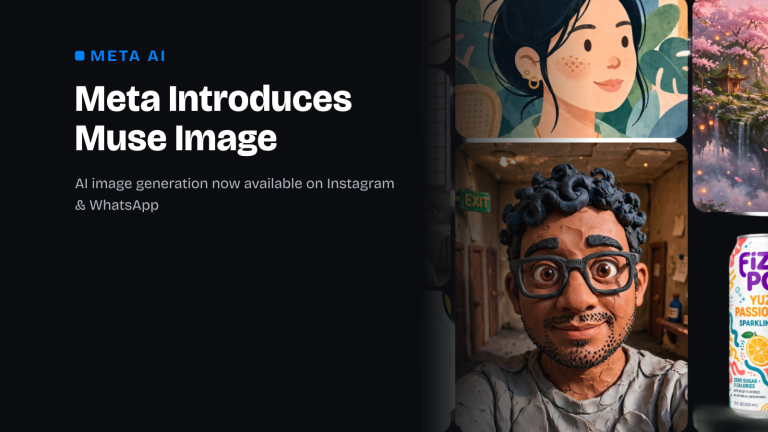
Meta has introduced Muse Image, its first image generation model from Meta Superintelligence Labs, making the model available in Meta AI and across selected creative experiences inside the company’s apps. The product launch gives Meta a new answer to one of the most important questions in consumer AI: where will image generation actually become a daily habit?
The company says Muse Image can understand complex prompts, blend multiple photos, edit images directly, use suggested presets, and create visuals that can be downloaded or shared into a chat, story or feed. It also powers more than 30 AI effects for Instagram Stories and image generation inside direct chats with Meta AI on WhatsApp, starting in limited countries. Meta says Muse Image is coming soon to Facebook, Messenger and advertisers through Advantage+ creative.
The signal is not only that Meta has another AI image model. The bigger shift is distribution. Image generation is moving from isolated creative tools into social products with billions of user habits already in place. If Meta can make AI creation feel native inside messaging, stories, ads and feeds, the competitive layer may shift from model quality alone to workflow, identity, social context and shareability.
What Muse Image does
Muse Image is designed for both text-to-image generation and image editing. Users can start with a text prompt, work from an existing photo, remove objects, restore old images, generate clean text inside visuals, create infographics, or make edits by circling and sketching directly on an image. Meta says the model can preserve context across a conversation, allowing users to refine images without starting again.
Meta is also leaning into presets. Instead of expecting every user to write detailed prompts, Meta AI now includes suggested prompt panels that can restore family photos, change hairstyles, reimagine a user as a claymation character, or turn a person into a 16-bit video game-style avatar. This matters because prompt design remains one of the friction points in consumer AI. Presets turn image generation from a blank canvas into a tap-led creative experience.
The model also supports room redesigns. Users can photograph a room and ask Meta AI to restyle it with real products from the web or Facebook Marketplace. That points to a commercial use case beyond entertainment: AI-assisted shopping, interior inspiration and marketplace discovery.
The technical angle: Muse Image acts more like an agent
Meta’s AI research blog frames Muse Image as an agentic image generation model rather than a simple prompt-to-image system. Instead of directly mapping a prompt to a visual output, Muse Image can use tools, search for context, write and execute code for certain image tasks, refine its own generations, and use more inference-time compute to improve results.
That technical framing is important. The pressure point in AI image generation is no longer only whether a model can create a beautiful image. It is whether the model can follow instructions, edit specific parts of an image, preserve visual coherence across multiple turns, handle text accurately, blend references, and reason through a user’s intent.
Meta says Muse Image can compose elements from multiple reference images, including people, objects, clothing, styles and environments. The company also says the model can interleave text and image inputs for more complex visual compositions.
This moves Muse Image closer to a creative assistant than a one-shot generator. The commercial question is whether users and advertisers will trust it for repeatable, brand-safe, editable creative work, not just fun experiments.
Why this matters for Meta
For Meta, Muse Image connects directly to three strategic surfaces: consumer AI, social creation and advertising.
On the consumer side, Meta AI becomes more useful when it can create personalized, shareable visuals inside the places people already communicate. On the social side, Instagram Stories and WhatsApp chats give Muse Image built-in distribution. On the advertising side, Advantage+ creative gives Meta a path to make generative visuals part of campaign production for brands and agencies. Meta says advertisers and agencies will be able to access Muse Image through Advantage+ creative in the coming weeks.
The advertising angle may become especially important. If brands can generate, adapt and test visuals inside Meta’s ad system, the creative production cycle could become faster. That would also deepen Meta’s position in the full ad workflow: audience targeting, creative generation, campaign optimization and measurement.
But it also raises harder questions. AI-generated ad creatives need brand consistency, usage rights clarity, content safety, accurate product representation and provenance. Meta’s inclusion of Content Seal, an invisible watermarking system for Muse Image outputs in the Meta AI app and on meta.ai, is one attempt to address provenance. Meta says the watermark is designed to remain intact even when images are cropped, compressed, resized or screenshotted, and that it plans to extend Content Seal to video.
The market signal
Muse Image points to a wider market shift: generative AI media is becoming embedded infrastructure.
Open-ended image tools were the first phase. The next layer is AI creation inside the products where people already express identity, talk to friends, build brands, sell products and run campaigns. Meta’s advantage is not only model development. It is product surface area.
Instagram can turn image generation into a creator feature. WhatsApp can make it conversational. Facebook Marketplace can connect visual redesigns to commerce. Advantage+ creative can make it useful for advertisers. Meta AI can become the central assistant layer that ties those surfaces together.
That gives Meta a different kind of AI distribution than standalone creative startups. The company does not need every user to visit a separate image-generation website. It can insert Muse Image into existing flows: a story effect, a chat prompt, a room redesign, a marketplace idea or an ad creative variation.
The risk is product clutter. If AI effects feel gimmicky, repetitive or low-quality, users may treat them as novelty features. If they are accurate, editable, personal and easy to share, they could become a recurring creative behavior.
What to watch next
The next layer is adoption and control.
Meta says Muse Image is currently available in Meta AI, on meta.ai, Instagram Stories in the US and WhatsApp in limited countries, with Facebook, Messenger and more surfaces coming later. Muse Video is also in development and is expected to come to creators and Meta AI.
What matters now is how Meta balances capability with trust. Image generation inside social platforms touches identity, likeness, public profiles, advertising, shopping and misinformation risk. Meta says users can control whether their Instagram content can be tagged for AI creation through a setting, which will matter as the model begins using public social context in creative outputs.
For consumers, Muse Image is a creativity feature. For creators, it is a faster production tool. For advertisers, it may become part of creative automation. For Meta, it is another step toward making AI native across its family of apps.
The strategic bet is clear: the future of AI image generation may not be won only by the model that produces the best single image. It may be won by the platform that makes generation, editing, sharing and commerce feel like one continuous workflow.