Microsoft-Decision-1 is not designed to write, summarize or reason in paragraphs. Its job is narrower: make fast, structured decisions inside AI systems, then return probabilities that software can act on.
That distinction matters because modern AI applications increasingly contain many more decisions than generative steps.
An agent might use a powerful reasoning model to understand a task, then repeatedly decide which tool to call, whether an action is safe, how urgent an incident is, which model should handle the next step or whether a result needs human review. Microsoft’s argument is that routing every one of those decisions through a general-purpose LLM adds unnecessary latency and cost.
Microsoft released Microsoft-Decision-1 in public preview through Microsoft Foundry, with access also available through OpenRouter. The model is built on Qwen3.5-9B, post-trained by Microsoft for single-pass decision scoring, and the company says future versions are expected to be rebased on Microsoft MAI and OpenAI models.
Microsoft-Decision-1 at a glance
| Attribute | Microsoft-Decision-1 |
|---|---|
| Base model | Qwen3.5-9B |
| Product status | Public preview |
| Main role | Classification, routing, ranking, grading and workflow control |
| Input | Text or structured JSON state |
| Output | Structured choice, score or probability |
| Free-form generation | No |
| Written explanation | No |
| Deployment | Microsoft Foundry; OpenRouter |
| Foundry deployment modes | GlobalStandard; DataZoneStandard in supported regions |
| Input price | $0.042 per 1M tokens |
| Output-token charge | None reported by Microsoft |
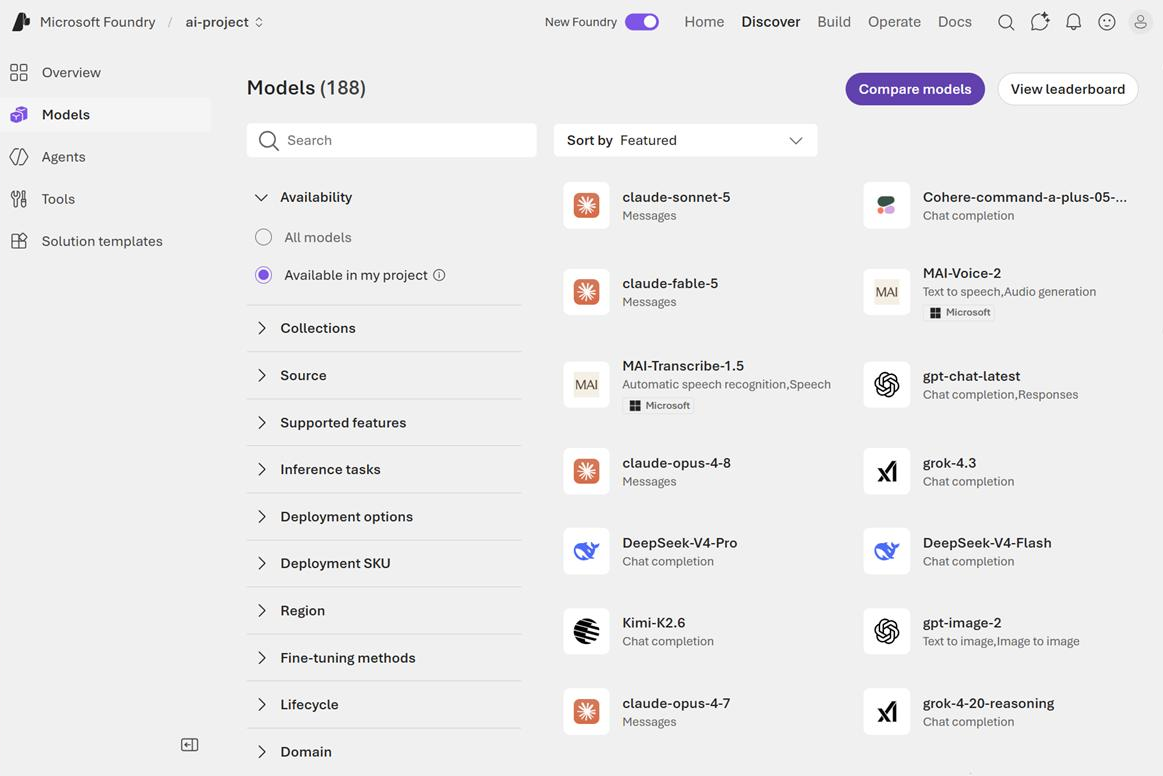
Suggested in-article visual: Microsoft Foundry model environment
The image below provides visual context for the Foundry model catalog where Microsoft is positioning specialized models alongside broader generative systems.
How Microsoft-Decision-1 actually works
The model receives a state and one or more bounded questions. Instead of producing prose, it evaluates the available options and returns numerical results that application logic can use.
Microsoft currently exposes three main decision primitives.
| Decision type | What the application asks | What the model returns | Example |
|---|---|---|---|
| Noul | Is this condition true? | Probability from 0 to 1 | Does this action touch production data? |
| Choice | Which option fits best? | Selected option + probability for each option | Billing, engineering or account support? |
| Score | How much / how severe? | Ordered score + probability distribution | Cosmetic, minor, major or critical incident |
That design changes the role of AI inside an application.
A generative model could draft a customer-support response. Microsoft-Decision-1 could separately decide whether that response meets policy, which team should receive it and whether its confidence is high enough to continue automatically.
Microsoft Learn explicitly recommends using a generative LLM when an application needs to create, summarize, rewrite or explain content, and Microsoft-Decision-1 when the application needs a bounded judgment.
Why Microsoft is separating generation from decision-making
The architectural argument is latency.
If an agent makes many sequential decisions, even a small delay compounds. Microsoft gives the example that adding 100 milliseconds across 20 sequential decisions adds two seconds to the workflow.
That makes a specialist model potentially useful in systems where an agent repeatedly asks questions such as:
Which tool? Which model? Continue or stop? Safe or unsafe? Human review or automation? Which queue? Which priority?
Instead of making one flagship LLM responsible for every task, the system can separate:
Generation → Reasoning → Decision → Action
This is closer to a modular software architecture than the early pattern of using one chatbot model for everything.
What Microsoft’s benchmarks show, and what they do not
Microsoft reports that Decision-1 achieved the highest accuracy in its 36-benchmark evaluation, covering nearly 150,000 questions that the company says were kept blind from training. Microsoft also reports that it was 2.5× faster than H2O-Lightning-4B v1.1 and roughly 35× faster than GPT-6 Sol in its testing.
Microsoft also tested robustness by modifying equivalent requests in eight ways. The company reports an average 1.3% decision-flip rate, with no flips when option descriptions were paraphrased or options were reordered in specific tests.
These numbers are useful, but they should be read correctly:
| Metric | Microsoft-reported result | Important qualifier |
|---|---|---|
| Benchmark suite | 36 benchmarks | Includes Microsoft’s evaluation methodology |
| Questions | Nearly 150,000 | Company-reported |
| Speed vs H2O-Lightning-4B v1.1 | 2.5× faster | Microsoft benchmark |
| Speed vs GPT-6 Sol | ~35× faster | Microsoft benchmark |
| Average perturbation flip rate | 1.3% | Across Microsoft’s eight perturbation tests |
| Safety testing | 5,250 requests across 11 benchmarks | Microsoft-run evaluation |
These are Microsoft-run measurements, not independent third-party validation. Developers still need to benchmark the model on their own traffic and task definitions.
Where decision models could matter most
The clearest use case is not replacing the main reasoning model. It is handling the high-frequency control decisions surrounding it.
Microsoft lists applications including support routing, incident prioritization, content filtering, model selection, tool selection, response grading, data validation and agent workflow control.
One Microsoft example comes from Xbox Research, where the company says Decision-1 categorized more than 10,000 pieces of open-ended feedback into researcher-defined themes while achieving quality competitive with GPT-5 and running 80-100 times faster in that internal workload. This remains a Microsoft-reported deployment result.
That illustrates the broader idea: the expensive model handles ambiguity; the decision model handles repetition.
The probabilities are useful, but they are not certainty
Microsoft-Decision-1 does not provide a written rationale for its decisions. That makes confidence thresholds central to deployment.
Microsoft recommends testing those thresholds on representative labeled data and sending uncertain cases to another model or a human. Developers can also include an abstention option such as “cannot tell” rather than forcing the model to choose.
Microsoft’s documentation also identifies several limitations:
- results can change with question wording or option order;
- calibration can weaken on unfamiliar tasks;
- the model can reflect bias in its base model and training data;
- safety filters can miss harmful content or flag benign content;
- the model may rely on outdated knowledge.
For consequential decisions involving employment, credit, housing, healthcare or legal matters, Microsoft explicitly advises meaningful human review and says the model should not be the sole decision-maker.
Microsoft-Decision-1 signals a larger change in AI architecture
The most important part of Microsoft-Decision-1 may therefore be less about this specific 9B model and more about the architecture it represents.
The first phase of generative AI encouraged developers to ask:
Which single model should power my application?
Agentic systems are increasingly creating a different question:
Which model should handle each step?
A reasoning model may plan. A generative model may write. A retrieval system may fetch evidence. A decision model may determine what happens next.
Microsoft-Decision-1 turns that last function into its own model category.
If the approach proves reliable outside Microsoft’s benchmarks, the next generation of enterprise AI systems may be optimized not around one increasingly capable model, but around a portfolio of specialized models coordinated around cost, latency, confidence and risk.


