From designing electronic devices to exploring new car designs with Mazda, OpenAI is testing how artificial intelligence can help engineers create physical products.
OpenAI is bringing artificial intelligence into physical engineering, showing how its models can help design electronic devices, develop vehicle components, and prepare products for manufacturing. In a research announcement on November 3, 2026, the company demonstrated a hardware prototype designed with GPT-6 Astra, announced a new collaboration with Mazda, and expanded its engineering research with Chip Ganassi Racing.
The work reaches beyond the familiar experience of asking ChatGPT a question or using AI to write code. OpenAI is now testing how AI can assist with the drawings, electronics, simulations, and technical decisions that go into making physical products.
Think about something as ordinary as a smartphone, a car, or an electronic gadget. Before it reaches someone’s hands, engineers must figure out how its components fit together, how its electronics work, and whether the design can actually be manufactured. OpenAI wants its AI models to help with that process, giving engineers more ways to explore and improve their ideas.
Two Engineers Used AI to Design a Physical Device in Under a Week
OpenAI’s most tangible demonstration began with a simple idea: build a device that lets people talk to Codex, the company’s AI coding assistant.
Creating even a small electronic product requires several different kinds of engineering. Someone must design the outer casing, select the electronic components, arrange the circuit board, and develop software that makes everything work together.
For this experiment, OpenAI used GPT-6 to define the device’s functional requirements, while GPT-6 Astra worked on its appearance, mechanical design, electronics, interface, and software integrations.
The AI contributed to several parts of the project:
- Physical Design: Creating the device’s appearance, enclosure, and internal component supports.
- Electronic Engineering: Selecting components and designing the printed circuit board that connects them.
- Software Development: Generating firmware, user-interface elements, and integrations with Codex.
According to OpenAI, two employees completed the initial design in under one week while working on the experiment as a side project. A contract manufacturer then produced a small batch of prototypes in less than a month.
Those results offer an interesting glimpse of AI-assisted hardware development. A process involving mechanical engineering, electronics, and software was brought together through AI-supported design tools.
However, the experiment also revealed an important limitation. Preparing the device for manufacturing required several rounds of review and revision because Astra did not consistently account for production limits, assembly requirements, and manufacturing tolerances.
The AI helped create the design. Engineers still had to make sure it could be built.
Mazda Is Exploring How AI Could Help Design Better Cars
Designing a car requires more than making it look attractive. Engineers must consider how air moves around its body, how its structure performs, and whether the design can be manufactured at an acceptable cost.
Those requirements do not always lead to the same answer.
A shape that improves aerodynamics might not match the appearance a designer wants. Changing one part of the vehicle can create new challenges elsewhere.
That is one of the problems Mazda is exploring through a new research collaboration with OpenAI.
The companies are bringing together OpenAI’s research and engineering teams with Mazda’s aerodynamics and crash-safety engineers to investigate how AI can help generate, simulate, and evaluate vehicle designs.
One experiment uses GPT-6 Astra in Codex to explore different shapes for the front of a car. The system can help model alternative designs, simulate how air flows around them, and refine promising options.
Mazda Principal Engineer Akihiro Nakata described a familiar tension between engineering and design. When engineers identify a shape that improves airflow, designers sometimes ask, “Does it have to look like that?”
Exploring more variations could help the teams understand which shapes influence aerodynamic performance while preserving Mazda’s design identity.
The research also covers simulations involving vehicle structures and crash safety.
For drivers, the potential benefit is easy to understand: carmakers may eventually be able to examine more design possibilities before deciding which ones to develop further.
Mazda has not announced an AI-designed production vehicle or a measured improvement in vehicle performance from this research. The collaboration is still focused on testing what these tools can do.
From the Racetrack to the Drawing Board
OpenAI is also expanding its collaboration with Chip Ganassi Racing, bringing AI-assisted engineering into the development of physical racing components.
Imagine an engineering team has a mechanical part in front of it but cannot find the original design files. Recreating that part digitally can require careful measurements and detailed modeling before anyone can modify or reproduce it.
OpenAI and Chip Ganassi Racing are testing whether AI can make that work easier.
Their approach involves taking 3D scans of existing components and converting them into editable computer-aided design (CAD) models and manufacturing drawings.
A CAD model is essentially a precise digital representation of a physical object. Engineers can use it to examine dimensions, make changes, and prepare further design work.
Chip Ganassi Racing’s engineers review the AI-generated models and drawings to determine whether they are accurate and suitable for manufacturing.
The collaboration extends OpenAI’s earlier work with the racing team, which focused on making better use of vehicle sensor data and race information.
The latest experiments take the partnership further into the engineering of physical components. For racing teams, where small design changes can matter, reducing repetitive modeling work could give engineers more time to evaluate improvements.
How Good Is AI at Real Engineering Tasks?
OpenAI is also measuring whether newer models are becoming more capable of handling specialized engineering work.
The company reported results from BenchCAD 2.0, an evaluation that tests how well AI models reconstruct three-dimensional components, assemble mechanical parts, and identify electrical connections on circuit boards.
An unnamed newer internal OpenAI model scored 0.875, compared with 0.594 for GPT-6 Astra at its highest reasoning setting.
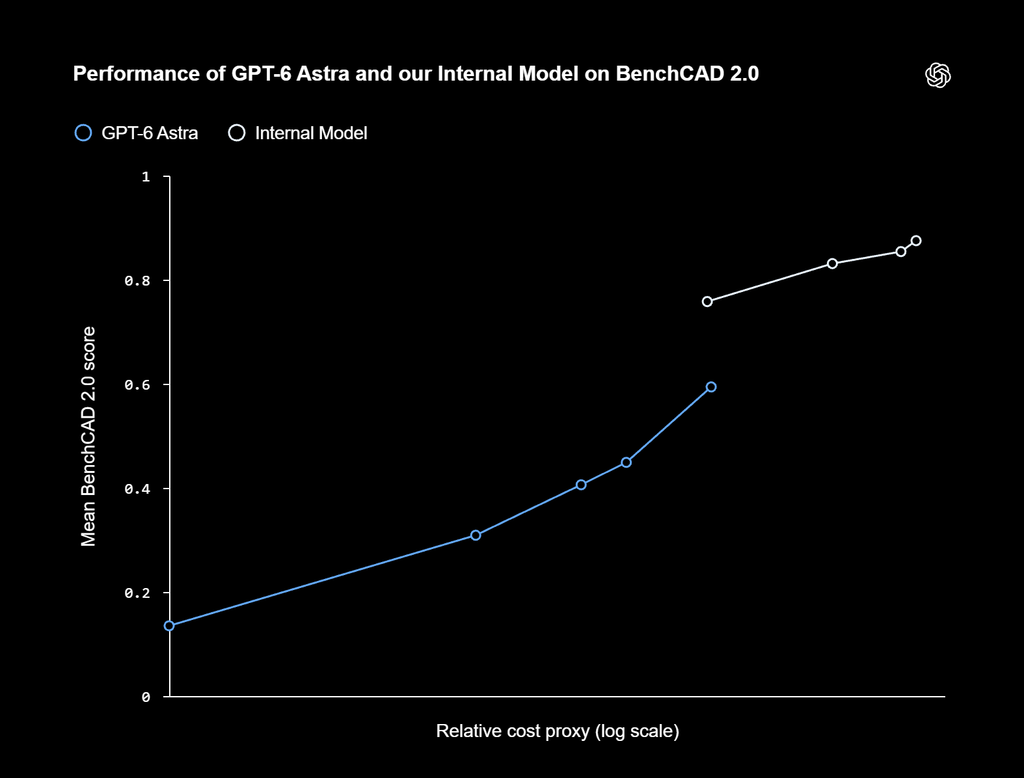
The BenchCAD research team acknowledged the reported result on November 3, 2026. OpenAI did not announce a public release of the higher-scoring model.
The improvement is significant within the benchmark, but there is a practical distinction worth understanding.
In earlier BenchCAD testing, researchers found that AI models sometimes generated the correct mechanical parts but placed them in the wrong positions.
Anyone who has struggled to assemble furniture knows how frustrating that can be. Every component might be present, yet one incorrectly positioned piece prevents everything from fitting together.
Engineering presents similar challenges, often with much tighter requirements.
A convincing 3D design is only part of the job. Its dimensions, component placement, and connections must also be correct.
The BenchCAD results measure progress on selected engineering tasks. They do not establish that AI can independently design and manufacture reliable products without professional verification.
What Could This Mean for the Products We Use?
OpenAI says its own hardware teams are already using ChatGPT and Codex to create and revise CAD models, prepare technical drawings, run simulations, and review designs.
The company reports that model usage across these teams, measured in tokens, has increased 23-fold since February 2026.
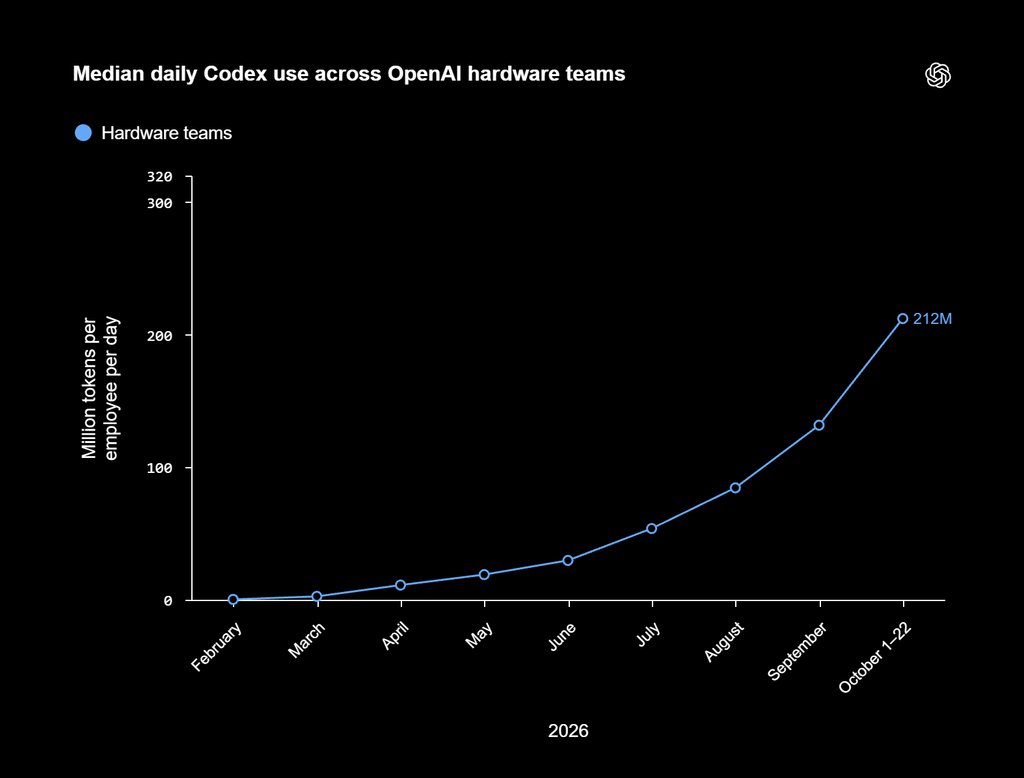
That indicates greater use of the technology, although it does not mean engineers are working 23 times faster.
The potential benefit lies in how engineering teams spend their time. AI could help prepare drawings, explore alternatives, and handle some repetitive tasks, allowing specialists to concentrate on design decisions, testing, and manufacturing requirements.
The work with Mazda, Chip Ganassi Racing, and OpenAI’s own hardware teams illustrates different ways that could happen.
For people who eventually buy and use these products, the technology may be almost invisible. What matters is whether it helps engineers develop reliable products, explore useful improvements, and solve problems before those products reach customers.
There is still considerable work ahead. AI-generated designs must satisfy the physical constraints of materials, electronics, safety, and manufacturing. OpenAI’s own prototype showed why professional review remains essential.
A product can look perfect on a computer screen. The real achievement is making sure it works when someone holds it in their hands.
OpenAI’s latest research brings AI further into that process, with engineers continuing to determine which designs are ready for the real world.


