Apple introduces a touchscreen MacBook Pro with tandem OLED technology, a lighter design, Dynamic Island, and professional AI capabilities, starting at $2,899 in India.
Apple has unveiled its first touchscreen MacBook Pro, introducing a new way for professionals to create directly on their laptop displays. Announced on October 28, 2026, the redesigned 14-inch and 16-inch models combine the PROLED XDR tandem OLED display, M5 Pro and M5 Max processors, Dynamic Island, and a significantly lighter design.
Starting at ₹3,49,900 in India, the new MacBook Pro brings touchscreen interaction to Apple’s professional laptop lineup for the first time, alongside brighter visuals, greater color precision, and expanded storage options.
Imagine adjusting a video timeline directly with your fingers, painting on a digital canvas, or playing a virtual piano on your laptop screen. These are the creative workflows Apple is bringing to the MacBook Pro through its new touch-enabled display and software.
What’s New in Apple’s Touchscreen MacBook Pro?
Apple’s October redesign builds on the M5 Pro and M5 Max MacBook Pro models introduced in March 2026.
The processors remain familiar, but the display, interaction experience, portability, and several professional features receive significant upgrades.
| Feature | MacBook Pro | MacBook Pro (PROLED XDR Display) |
|---|---|---|
| Touchscreen | No touchscreen | First integrated Multi-Touch display |
| Display Technology | Liquid Retina XDR with mini-LED | PROLED XDR with tandem OLED |
| Peak HDR Brightness | Up to 1,600 nits | Up to 2,000 nits |
| Contrast Ratio | 1,000,000:1 | 10,000,000:1 |
| Color Support | P3 wide color gamut | P3 and Adobe RGB |
| Dynamic Island | Not available | Introduced on MacBook Pro |
| 14-inch Weight | 1.60 kg | 1.38 kg |
| 16-inch Weight | 2.14 kg | 1.82 kg |
| Maximum Storage | Up to 8TB SSD | Up to 16TB SSD |
| Audio System | Six-speaker system | Redesigned six-speaker system with 50% deeper bass |
| Processors | M5 Pro and M5 Max | M5 Pro and M5 Max |
| Battery Life | Up to 24 hours | Up to 24 hours |
Touch Finally Comes to MacBook Pro
For years, the MacBook Pro relied on its keyboard and trackpad for precise creative work. Apple now adds direct touchscreen interaction while retaining those familiar controls.
The display supports swiping, pinching, dragging, window management, and direct interaction with creative content.
The change becomes particularly interesting when applied to professional software.
Apple’s Creator Studio applications are being optimized for touch:
- Final Cut Pro: Editors can mark video ranges, move clips into position, and pinch to zoom into a timeline.
- Pixelmator Pro: Designers can draw, paint, select, and manipulate elements directly on the display.
- Logic Pro: Musicians can use an on-screen Multi-Touch keyboard, chord pads, and drum controls.
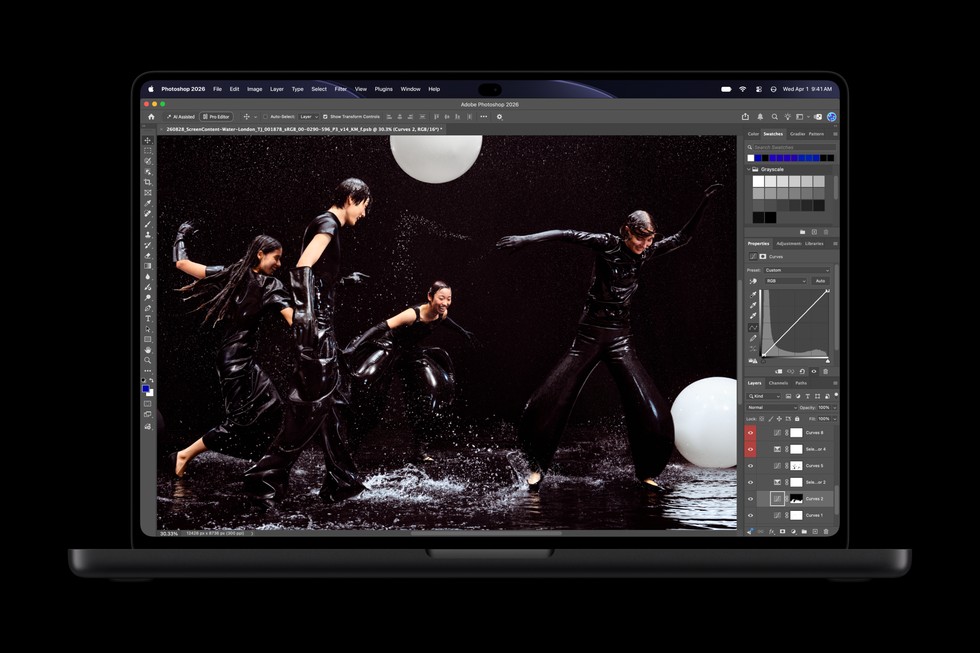
Apple has integrated the touch sensor directly into the display panel to minimize latency. A redesigned hinge also provides additional stability when users interact with the screen.
Existing macOS applications can interpret touches as clicks, while updated APIs allow developers to introduce more advanced gestures.
Apple says the Creator Studio updates will arrive in November, with additional third-party applications expected to expand their touch support over time.
PROLED XDR Brings a Major Display Upgrade
The most significant hardware improvement extends beyond touch.
Apple’s new PROLED XDR display uses two self-illuminating OLED pixel layers, replacing the mini-LED architecture of the previous MacBook Pro.
The technology is designed to produce deeper blacks, brighter highlights, and more consistent colors.
For a filmmaker editing HDR footage, that means greater visibility in bright and dark areas of an image. For photographers and designers, the expanded color gamut provides more flexibility when working across digital and print projects.

According to Apple, PROLED XDR delivers:
- 2,000 nits peak HDR brightness, compared with 1,600 nits previously.
- 10,000,000:1 contrast ratio, compared with 1,000,000:1.
- Up to 1,000 nits sustained full-screen brightness.
- 10Hz–120Hz adaptive refresh rates.
- P3 and Adobe RGB color support, with more than 80% Rec. 2020 coverage.
- An anti-reflective coating, with optional nano-texture glass.
The display also supports professional calibration and reference modes for color-sensitive workflows.
Importantly, the 2,000-nit figure represents peak brightness under specified conditions, while the sustained full-screen rating remains 1,000 nits.
M5 Pro and M5 Max Keep Professional AI at the Core
While the October MacBook Pro introduces a new display and design, Apple continues using the M5 Pro and M5 Max processors introduced earlier in 2026.
Both chips integrate Neural Accelerators into their GPU cores, supporting demanding applications such as local AI models, software development, 3D rendering, and high-resolution video production.
The new configurations offer up to 128GB of unified memory and 16TB of SSD storage on supported M5 Max models.
For developers and AI researchers, the available memory and GPU acceleration support large local models and complex workflows. Apple says supported M5 Max configurations can run language models containing hundreds of billions of parameters on-device.
The expanded storage capacity is particularly relevant to professionals managing large video libraries, production assets, and local datasets.
A Lighter MacBook Pro With Dynamic Island
Apple has also redesigned the laptop’s chassis, making both models thinner and lighter.
The 14-inch MacBook Pro weighs 1.38 kg, compared with 1.60 kg previously, while the 16-inch version drops from 2.14 kg to 1.82 kg in M5 Pro configurations.
A redesigned thermal system supports sustained performance within the slimmer body.
Another visible addition is Dynamic Island, bringing interactive controls and information to the top of the MacBook Pro display.
The feature supports Live Activities, music controls, and compatible Siri AI experiences. Spotlight integration depends on Siri AI being available and enabled.
The laptop runs macOS 27 Golden Gate, with Apple Intelligence features and Siri AI capabilities. Siri AI is available in beta through macOS 27.2, subject to supported languages and regions.
The redesigned six-speaker system also delivers 50% deeper bass, according to Apple.
Other professional features include Thunderbolt 5, Wi-Fi 7, Bluetooth 6, HDMI, an SDXC card slot, a 12MP Center Stage camera, and up to 24 hours of battery life.
Many of these connectivity and battery capabilities were already available in the previous generation.
MacBook Pro 2026 Price and Availability in India
Apple opened pre-orders on October 28, 2026, with availability in India scheduled to begin on November 9, 2026.
| New MacBook Pro Model | Starting Price in India |
|---|---|
| 14-inch MacBook Pro – M5 Pro | ₹3,49,900 |
| 16-inch MacBook Pro – M5 Pro | ₹4,09,900 |
| 14-inch MacBook Pro – M5 Max | ₹5,49,900 |
| 16-inch MacBook Pro – M5 Max | ₹5,89,900 |
For professionals considering an upgrade, the decision comes down to how they work.
Photographers, filmmakers, and designers have the most to gain from the tandem OLED display, wider color support, and direct touchscreen controls.
Developers and AI researchers can benefit from the available memory, storage, and existing M5-series processing capabilities.
For owners of the March 2026 M5 Pro or M5 Max models, the October redesign offers its clearest improvements in display quality, touch interaction, portability, and maximum storage, rather than an entirely new processor generation.
Early hands-on coverage also suggests that touch works as an additional input method alongside the keyboard and trackpad. Its longer-term value will become clearer as more professional applications support direct interaction.
Apple’s most meaningful change is bringing the creative workspace directly onto the screen. The MacBook Pro now combines the precision of traditional controls with a display professionals can touch, edit, and interact with as part of their everyday work.


