For almost twenty years, the iPhone has taught people new ways to use a phone without asking them to reconsider the object itself. The display grew, cameras multiplied, processors became powerful enough to run increasingly sophisticated software, and artificial intelligence began moving directly onto the device. Through all of it, the physical idea remained remarkably stable: one screen, one shape, one surface held in the hand.
A folding screen changes that assumption.
It creates a phone that can be compact one minute and expansive the next, sit upright without a stand, show different information to people on opposite sides, and give software something entirely new to understand: the physical position of the device itself.
That is where Apple’s iPhone Duo becomes interesting.
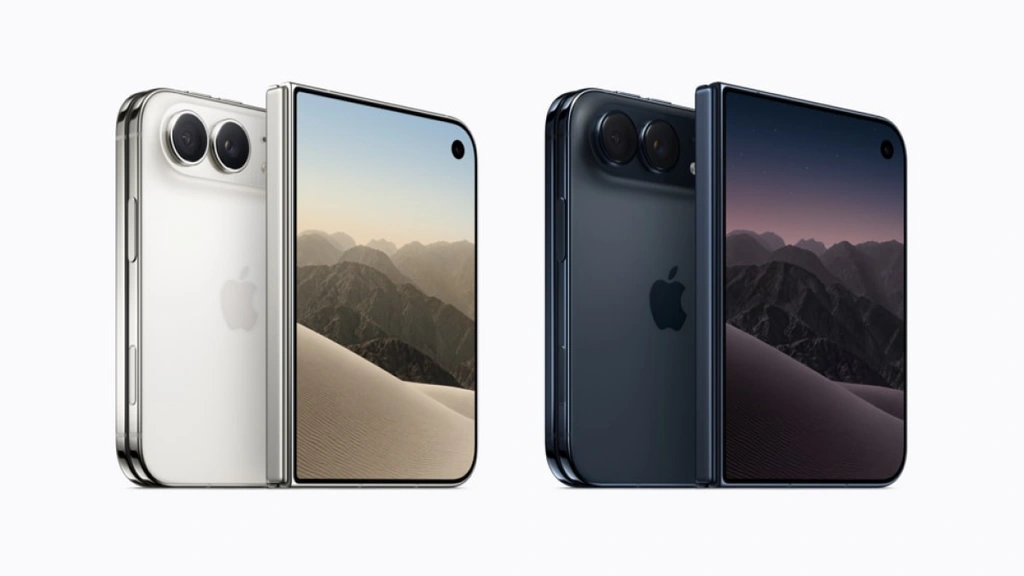
Apple’s first foldable iPhone opens from a 5.4-inch outer display into a 7.6-inch inner display, the largest ever on an iPhone. Yet the defining feature is less the extra screen area than what Apple has designed around it. iOS 27 adapts as the phone changes position, two apps can share the screen, the outer display becomes part of the camera experience, the battery is divided across the chassis, and an A20 Pro chip drives both displays while sustaining AI and graphics workloads through a custom vapor chamber.
The fold is the mechanism.
The experience Apple has built around it is the product.
iPhone Duo, before you open it
| Key specification | iPhone Duo |
|---|---|
| Inner display | 7.6-inch Super Retina XDR folding OLED |
| Outer display | 5.4-inch Super Retina XDR OLED |
| Inner resolution | 1878 × 2670, 430 ppi |
| Outer resolution | 1398 × 2034, 460 ppi |
| Refresh rate | ProMotion up to 120Hz |
| Outdoor peak brightness | 3,000 nits |
| Thickness when open | 5.2 mm |
| Thickness when closed | 11.3 mm |
| Weight | 254g |
| Processor | A20 Pro, 2nm |
| CPU / GPU | 6-core CPU / 7-core GPU |
| AI compute | Dual 16-core Neural Engine |
| Rear cameras | 48MP Main + 48MP Ultra Wide |
| Battery | Two-battery architecture |
| Video playback | 44h outer / 31h inner |
| Storage | 256GB to 2TB |
| Starting price | $1999 |
| Colors | Night Sky, Star White |
Apple says the Duo is just 5.2 mm thick when opened, making it the thinnest iPhone in that state, while the complete device weighs 254 grams. Both displays support ProMotion, Always-On Display, Dynamic Island, HDR and up to 3,000 nits of outdoor peak brightness.
The first achievement is not size. It is continuity.
Opening a foldable phone normally means moving from one type of screen to another. Apple has tried to make that transition feel less like switching devices.
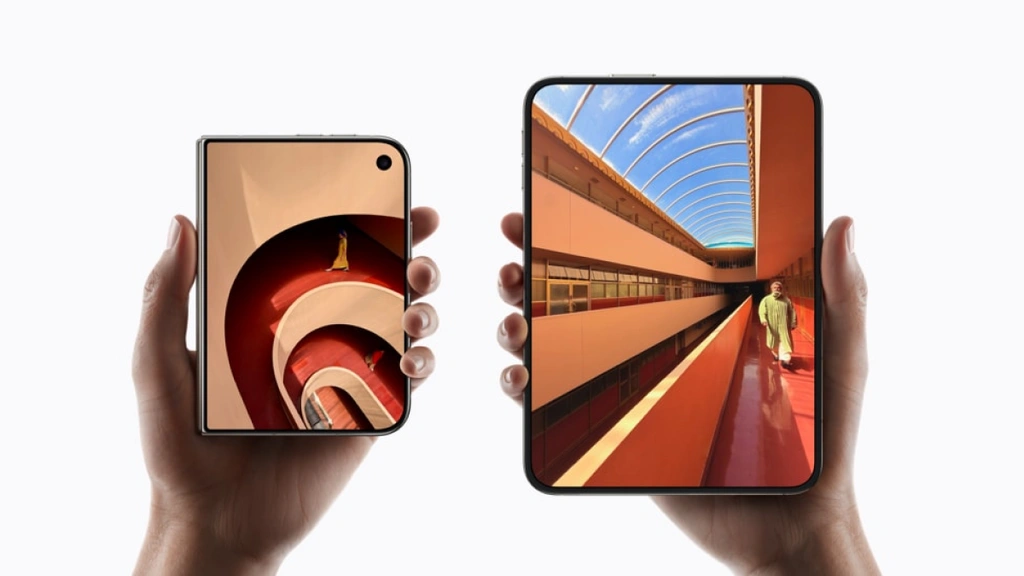
The 5.4-inch outer display provides roughly 90% of the screen area of the iPhone 18 Pro, so Duo remains practical without being opened for every message, call or quick interaction. Unfold it and the 7.6-inch inner display offers 50% more screen area than the iPhone 18 Pro Max. Apple has also given the two displays the same aspect ratio, allowing content to scale proportionally as users move between them.
That continuity is supported by an unusually complicated folding panel. Apple says the inner display contains 10 ultra-thin layers, uses wide-angle OLED technology and has a nano-texture surface designed to control glare. A FaceTime camera sits beneath the inner panel and remains visually hidden until required.
Later this year, Apple says Duo will also support Apple Pencil with USB-C on either display, allowing the large screen to move beyond viewing and multitasking into handwriting, annotation and sketching. Authentication is handled by Touch ID integrated into the side button, giving users the same biometric location whether Duo is open or closed.
The visual works here because it communicates the central idea immediately: Duo is still a usable phone while closed, but becomes something materially larger when opened.
A hinge gives iOS a new kind of input
The display may attract the attention, but Apple has spent just as much effort on what happens when the hardware begins moving.
iOS 27 is tailored specifically for iPhone Duo. App navigation, Home Screen controls and Lock Screen controls can move toward the sides to preserve vertical space. Open the device and two Home Screen pages can appear together, with Today View occupying the left side. Even Dynamic Island has been reshaped vertically to work along the edge of both displays, expanding when Live Activities or alerts require more room.
More importantly, content can react to the phone itself. Turn Duo and interfaces reorient. Fold it and content responds. Flip the device and the appropriate display can take over.
That creates five distinct ways of using the same hardware.
| Duo position | What changes |
|---|---|
| Closed | Compact outer-display iPhone experience |
| Landscape | Large horizontal canvas with Split View |
| Portrait | Wider keyboard, longer browsing canvas, video alongside another task |
| Seated | Upper display for content, lower area available for controls |
| Standing | Self-supporting outer display for video, FaceTime or StandBy |
The distinction matters because these are more than viewing angles. In Split View, two apps can run beside each other on an iPhone for the first time. Users can also open two windows from the same application, such as two Safari windows for comparing information, swap one side independently, talk to Siri AI while keeping another app visible, and save app pairings to return to later.
StandBy becomes more flexible for the same reason. Duo can rest on its own and enter StandBy on either display without needing to be connected to a charger, turning it into a photo frame, clock, weather surface or widget hub.
Apple has also prepared the software ecosystem around the format. Netflix, Zoom and Slack are among the third-party apps already adapting to Duo. Zoom can divide the large screen between shared content and participants, while Slack uses the expanded canvas to expose more of a workspace simultaneously. Apple is providing updated APIs and plans support for Duo in Device Hub in Xcode so developers can build specifically around the fold.
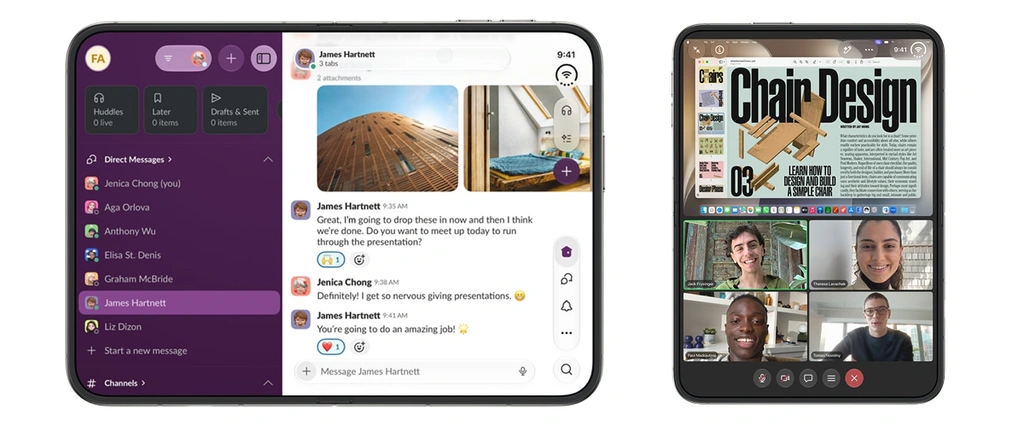
This is where Duo begins to separate itself from the simple idea of “a phone with a bigger screen.” The hinge becomes something the operating system understands.
Two displays change photography in ways another lens cannot
Apple could have used Duo’s outer display simply as the screen available when the phone is closed.
Instead, it turns that display toward the person on the other side of the camera.
The hardware starts with a 48MP Fusion Main camera and 48MP Fusion Ultra Wide, accompanied by a 12MP Center Stage camera and the under-display FaceTime camera inside. The Main camera can capture 24MP or 48MP images, includes sensor-shift optical stabilization and also provides an optical-quality 2x telephoto view. The Ultra Wide covers a 120-degree field of view and enables 48MP macro photography.
But Duo’s more memorable camera ideas come from having another screen facing the subject.
Duo Preview gives the person being photographed a live view of the frame, allowing them to adjust their pose themselves instead of waiting for instructions from behind the phone.
Kid Cue turns that same display into an attention tool, playing Peanuts animations where a child can see them so their eyes move naturally toward the camera.
Smart Take goes in another direction. On-device AI running on A20 Pro analyzes the scene and can recognize when the subjects are posing, automatically taking photographs so the person who set up the shot does not have to remain behind the camera or race against a timer.
And with Duo FaceTime, people physically beside the caller can participate through the outer display instead of crowding around the inner one.
These are surprisingly ordinary problems: getting into a group photograph, helping someone frame themselves, getting a child to look toward the lens, fitting several people into a video call.
The interesting part is that Apple solves them with the shape of the phone, rather than another camera specification.
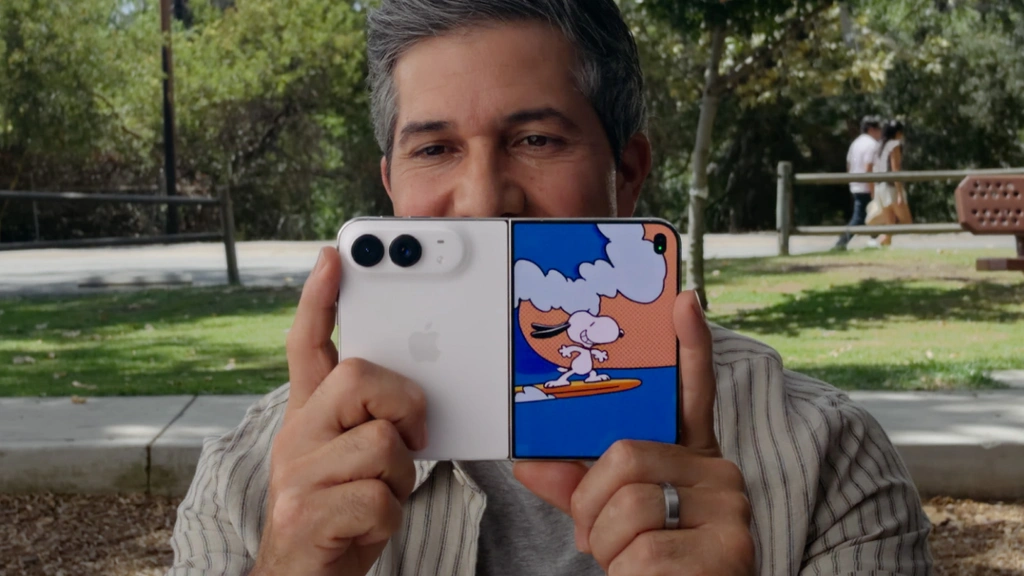
Behind the new camera interactions is still a flagship imaging system
Duo records 4K Dolby Vision at up to 120 fps through the 48MP Fusion Main camera, allowing users to slow high-frame-rate footage after capture. Apple has also added the ability to apply Cinematic effects after shooting at up to 60 fps, while updated Audio Mix algorithms can improve voices and isolate music. Time-lapse now supports 4K Dolby Vision HDR, and Duo’s self-supporting design means longer recordings can be captured without necessarily carrying a tripod.
Photography includes Smart HDR 5, the Photonic Engine, Deep Fusion, Night mode, next-generation portraits with Focus and Depth Control, panoramas up to 63MP, Photographic Styles with new texture and grain controls, and digital zoom up to 10x.
Apple Intelligence also enters the editing process. Spatial Reframing can change a composition after the picture has been taken, Extend can expand beyond the original frame, and the upgraded Clean Up tool can remove larger unwanted elements and reconstruct the surrounding background.
The fold therefore does not replace Apple’s traditional camera improvements. It creates a second layer of capability around them.
A foldable only works if the fold eventually disappears from your attention
A hinge looks simple from the outside. Apple’s version contains more than 100 components.
The mechanism supports the center of the display when Duo is opened, while an integrated magnet array helps secure it when closed. The enclosure is built from Grade 5 titanium, with a mirror-polished finish and a 3D-printed titanium hinge cover. Internal support ribs increase stiffness, while ceramic-fiber inserts around the antenna divisions reinforce the frame.
The inner display required its own approach to stress. Apple says a custom polymer in its nano-textured cover layer offers up to 40% greater stiffness than other materials used in the industry. High-strength glass sits above and below the flexible panel, while custom adhesives allow layers to move past one another during folding, reducing the stress created by repeated bending. A titanium plate beneath the panel adds another structural layer.
Ceramic Shield protects the rear, while Ceramic Shield 2 on the outer display is rated by Apple for three times better scratch resistance than the previous generation. The internal screen receives its own scratch-resistant coating, and Duo carries an IP68 rating, including Apple’s specified laboratory resistance to immersion at depths of up to six meters for 30 minutes.
These details may be less dramatic than opening a 7.6-inch screen, but for a first-generation foldable they are arguably more important. The transformation only feels useful when the mechanics stop demanding attention.
A20 Pro is doing more than making the phone faster
Driving two displays and a larger multitasking environment changes the performance problem.
Duo uses the same A20 Pro family as the iPhone 18 Pro, manufactured on Apple’s latest 2-nanometer process. It combines a six-core CPU, seven-core GPU with Neural Accelerators and a Dual 16-core Neural Engine. Apple claims a CPU improvement of up to 20% over A19 Pro, up to 40% faster GPU performance, twice the Neural Engine compute and 50% more unified memory bandwidth.
The more revealing figure is sustained performance.
Apple says Duo can deliver up to 35% better sustained performance than iPhone 17 Pro, helped by a package inspired by M-series Apple silicon that connects A20 Pro directly to a custom vapor chamber. The goal is to move heat away quickly enough to sustain demanding games, multitasking and local AI workloads rather than delivering performance only in short bursts.
There is also a dedicated display engine responsible for driving the inner and outer panels simultaneously and coordinating transitions between them.
That is a useful way to understand Duo’s performance story: A20 Pro is not simply powering a faster iPhone. It is supporting an iPhone with more screen, more states and more things happening at once.
Two sides. Two batteries. One power system.
Opening Duo reveals another consequence of the fold: the internals cannot be laid out like those of a conventional phone.
Apple places one high-energy battery on each side and uses silicon together with energy-rebalancing algorithms so the two packs behave as a single power system.
The result depends heavily on which display is being used:
| Battery use | Apple-rated endurance |
|---|---|
| Outer-display video playback | Up to 44 hours |
| Inner-display video playback | Up to 31 hours |
| Mixed use across both displays | Up to 24 hours |
| Outer-display streamed video | Up to 37 hours |
| Inner-display streamed video | Up to 26 hours |
Apple says a capable wired charger can take Duo to 50% in around 20 minutes, while suitable MagSafe charging reaches roughly 50% in around 30 minutes. MagSafe and Qi2 support wireless charging at up to 25W.
Duo is also eSIM-only worldwide. Apple says removing the physical SIM mechanism allows more internal volume to be dedicated to battery capacity. Two eSIMs can be active simultaneously, with eight or more stored on the device.
The fold changes the outside of the phone first. Here, it becomes clear how extensively Apple has rearranged the inside as well.
A larger display gives Apple Intelligence room to live beside the task
On a traditional smartphone, invoking an AI assistant often means temporarily giving most of the screen to the assistant.
Duo gives Apple another option.
Its large internal display can keep Siri AI on one side while another application remains visible on the other, allowing users to ask questions or request actions without losing sight of the material they are working with.
Siri AI, which Apple is rolling out in beta, can draw on personal context from messages, email, photos and other sources, understand content visible on screen, perform actions in apps and access broader online information. Users can also write and edit through Siri, while a dedicated Siri app keeps conversational history synchronized privately across Apple products through iCloud.
The Camera Control button also gains Siri Camera mode, allowing the assistant to use what the camera sees as context for questions and actions.
Other Apple Intelligence features extend across the system. Call Context can surface information such as an airline confirmation number while the user is already speaking with a business. Safari’s Notify Me can watch a page for changes such as a price drop or restock. Image Playground adds photorealistic generation, while upcoming SynthID support is designed to help identify imagery generated or edited using AI.
Apple says its intelligence architecture combines on-device processing with Private Cloud Compute when additional server-side capability is required. Siri AI remains a beta rollout with language, region and usage-limit restrictions, so individual functionality will not be universally available at launch.
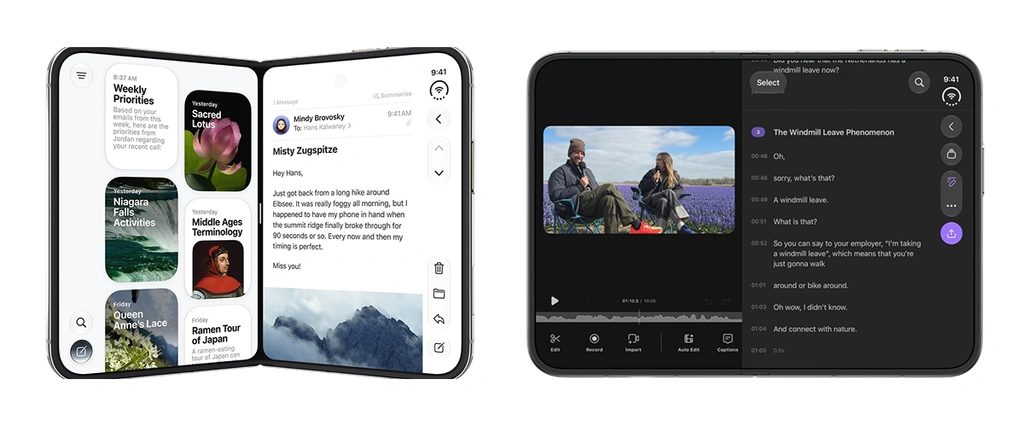
The significance here is less about making Siri visually larger. It is about giving AI enough screen space to coexist with the work it is helping with.
The wireless system has been rebuilt around Apple silicon too
Inside Duo is Apple’s N1 wireless chip, which enables Wi-Fi 7, Bluetooth 6 and Thread, alongside the company’s next-generation C2 cellular modem. Apple says C2 uses AI-powered techniques to improve cellular quality and reliability and supports mmWave connectivity in the United States.
iOS 27 also introduces iPhone Handoff for supported carriers, allowing the same phone number to move between two compatible iPhones more easily. Duo includes 5G, second-generation Ultra Wideband, NFC, precision dual-frequency GPS with NavIC support, and USB-C with DisplayPort plus USB 3 transfers at up to 10Gbps.
These are supporting technologies rather than headline features, but they complete Apple’s larger argument: a device with a different physical format should not require users to accept a narrower flagship experience elsewhere.
Even the accessories have to understand the fold
Apple is introducing a two-piece iPhone Duo Case in sand and navy blue, alongside a Duo Folio with Kickstand in navy blue and taupe.
The Folio’s retractable stand supports a range of angles for reading, FaceTime and video, while both accessories preserve MagSafe and Qi2 charging compatibility.
It may seem unusual for a phone that already stands by itself to receive another kickstand. The difference is range: Duo’s hinge creates specific postures, while the Folio expands the number of angles at which the device can remain supported.
The environmental engineering is unusually tied to the hinge
Apple reports that iPhone Duo contains 35% recycled material by weight, including 100% recycled cobalt in its batteries and 100% recycled titanium in the 3D-printed hinge cover. Apple also says 60% renewable electricity is used across manufacturing for the device and that its paper packaging is entirely fiber-based.
That hinge-cover figure is worth noting because additive manufacturing is doing more than shaping a complicated component. It also allows Apple to incorporate fully recycled titanium into one of the device’s defining structural parts.
Price, storage and availability
Duo comes in Night Sky and Star White, with 256GB, 512GB, 1TB and 2TB storage configurations. In India, Apple lists the starting price at ₹299,900 for 256GB, rising to ₹324,900 for 512GB, ₹374,900 for 1TB and ₹449,900 for 2TB.
Pre-orders begin in India at 5:30 PM IST on October 16, with availability starting October 23. Apple says the first launch wave covers more than 70 countries and regions.
The most important Duo feature cannot be measured in megapixels
iPhone Duo gives users something a regular iPhone cannot: more screen without carrying a larger device all the time. It stays compact when closed, but opening it creates room for two apps, larger photos, video calls and tasks that normally feel cramped on a phone. Apple is effectively trying to combine the convenience of an iPhone with the extra workspace of a much larger screen in one device.
The launch comes as Apple’s business in India reaches a new scale. Apple India reported FY26 revenue of ₹1,04,607 crore, up 32% year over year, while net profit rose 66% to ₹5,311 crore, according to Tofler data cited by The Economic Times. The results predate Duo, but they give Apple a growing market in which to introduce its newest premium iPhone form factor.
Early demand is already testing how much buyers will pay for that form factor. Preorders sold out quickly enough to push some delivery estimates into January 2027, while eBay sellers listed the device far above retail, including one 2TB iPhone Duo at $15,000 compared with Apple’s $3,199 price. The listings point to launch scarcity and strong early interest, though they do not yet show whether that demand will persist once supply improves.
The real test for iPhone Duo is whether today’s scarcity can turn into sustained demand. Apple is introducing its most expensive new iPhone form factor as its India business expands and early buyers show a willingness to pay steep premiums for immediate access. If that interest holds once supply catches up, Duo could become more than Apple’s first foldable, it could establish a new premium tier in the iPhone lineup.


