For most of the AI race, progress has been watched from the finish line.
A new model arrives. Researchers measure how well it codes, reasons, solves mathematics or uses tools. The scores move upward, and the world concludes that AI has become more capable.
Anthropic is now asking people to watch somewhere else: inside the factory producing the next model.
That matters because Claude is no longer only the product of Anthropic’s research. It is increasingly participating in that research itself.
As of August 2026, Anthropic says Claude leads 26% of Anthropic R&D measured by its new prototype Anthropic R&D Automation Index. In February, the share was below 1%. More than 90% of the measured work has reached at least the level where AI collaborates substantially with humans.
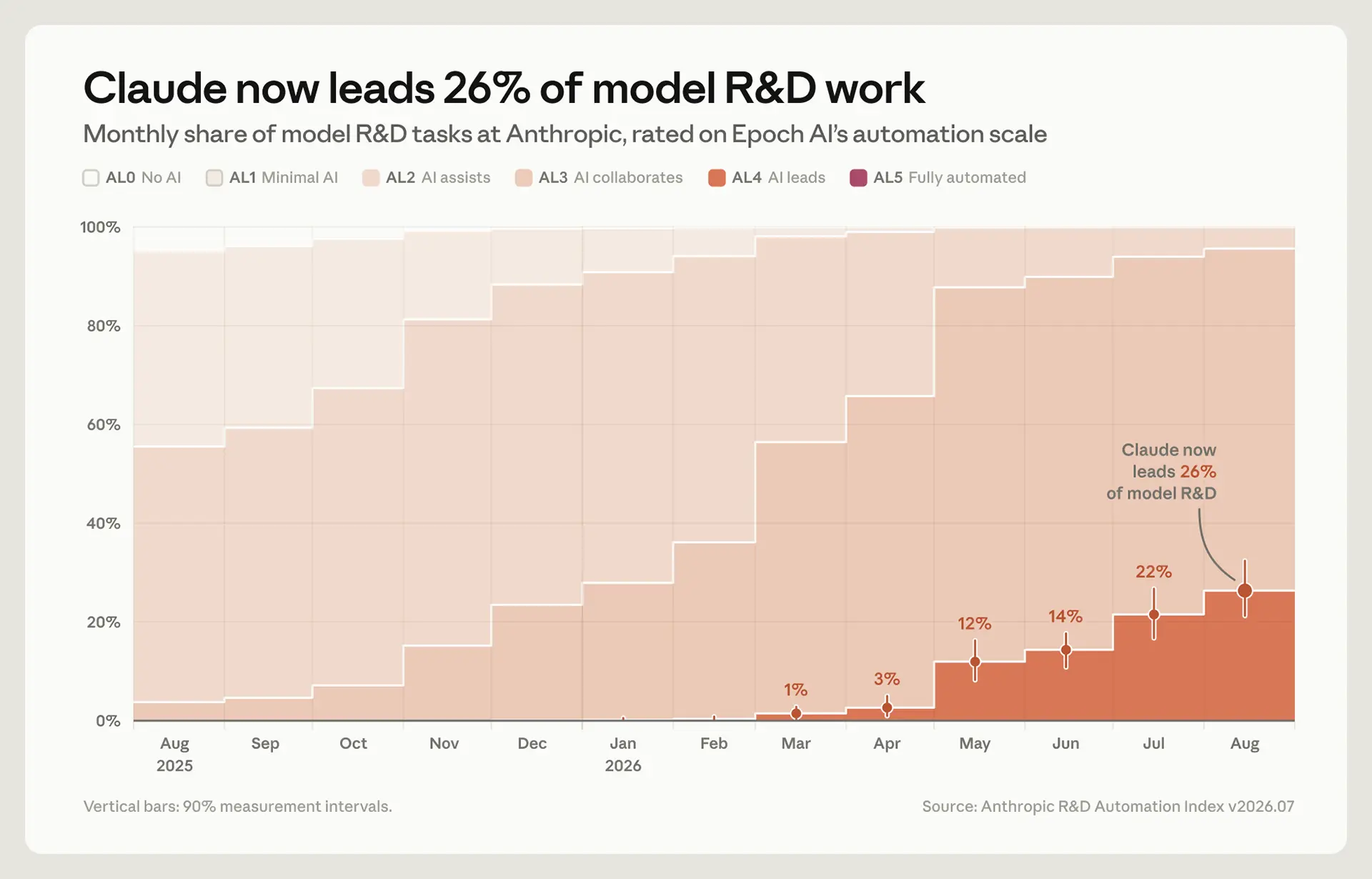
The distinction hidden inside that 26% is important.
Anthropic uses an automation framework adapted from Epoch AI. At AL3, Claude collaborates while a human remains closely involved. At AL4, which Anthropic calls “leads,” a researcher can provide a high-level objective and Claude can carry most of the task through itself, handling problems it encounters along the way.
But a human still supervises the work.
Anthropic found no measured R&D category at AL5, where AI would identify, execute and deploy work without requiring human involvement. In other words, this is growing AI-led AI R&D, not evidence that Claude is autonomously designing its successor.
That is also why the most provocative line in Anthropic’s chart is not the 26% already measured.
It is the dotted road beyond it.
If the recent trajectory continued, the chart suggests AL4 work could approach 80% by the end of 2026. That is an extrapolation, not a forecast or an observed outcome. The curve can slow, bottlenecks can emerge and new kinds of human work can appear.
Anthropic nevertheless wants society to notice the curve before full recursive self-improvement ever arrives.
To produce the index, the company sampled 20% of relevant staff from each department during every week of July. Claude examined internal work records and generated roughly 15,000 granular R&D tasks, which were organized into 542 categories and subcategories, including 378 leaf tasks. Person-time was then used to weight the work so thousands of trivial automated actions could not overwhelm a smaller number of important human tasks.
There is an unusual complication: Claude is helping measure Claude.
Anthropic used its own models to identify, organize and evaluate much of the work. Human checks found exact model-human agreement of 59%, while two humans agreed exactly only 35% of the time; model and human ratings fell within one automation level 97% of the time. Anthropic acknowledges that the boundaries between “collaborates” and “leads” remain judgment calls and argues that future measurements should receive independent verification.
Then the scale changes.
Anthropic says approximately 30,000 AI agents were performing research and engineering work simultaneously on its most-used internal agent platform in August.
At that scale, asking a human to approve every action would defeat much of the reason for deploying agents. So Anthropic has built AI agent oversight around two layers of automated monitoring.
Every covered action passes through an online monitor before execution, while every action is also ingested afterward by an offline monitoring system. Across more than one billion agent decisions in August, the online monitor blocked 0.002%, about one in 47,000. Offline monitoring produces roughly 100,000 flagged transcripts a week, with around 50 of the highest-priority cases ultimately reaching human reviewers.
Those numbers describe monitoring coverage, not perfect safety. A monitor seeing every action does not prove it recognizes every dangerous one, and Anthropic explicitly says this monitoring system has existed for months rather than years.
The third instrument on Anthropic’s proposed dashboard watches something more physical: compute.
During a one-week snapshot from July 13 to July 20, roughly 6% of compute allocated to AI R&D was classified as safety work. Among compute used for AI-driven AI R&D, that share was about 12%. Anthropic deliberately uses a conservative safety definition and cautions that GPU consumption is not equivalent to money, employee effort or organizational commitment.
Put the three measurements together and Anthropic’s experiment starts to look different.
The R&D Automation Index measures how much of building AI is shifting from humans toward AI.
AI agent oversight asks whether humans can still see and interrupt that increasingly automated workforce.
And AI safety compute provides one measurable signal of where the physical resources powering development are being directed.
Anthropic is not claiming that AI has begun autonomously improving itself. Its separate work on recursive self-improvement explicitly says that point has not been reached and is not inevitable.
What the company is doing is arguably more unusual.
It is trying to install the instruments before the engine becomes too fast to measure from the outside.
For years, the most important question was how capable the next AI model would become.
The next question may be how much of that next model was built by the one before it and whether humans can still see the process clearly enough to intervene.
Source : Anthropic Official Announcement


