Most people who work with AI long enough eventually discover the same trick.
The first answer is not quite right, so instead of starting over, you send it back:
Check your work. Find the weaknesses. Improve the answer.
The second response often feels noticeably better. The argument is cleaner. An awkward paragraph disappears. The model catches a contradiction you missed. Ask it to review the answer once more and it may tighten the reasoning again.
That experience makes AI self-reflection feel surprisingly intelligent.
And, in many situations, it is genuinely useful.
The problem begins when we quietly replace one claim with another: the answer improved, therefore the answer is now correct.
Those are not the same thing.
Research on LLM self-correction increasingly points to that distinction. Self-Refine, an influential 2023 study, showed that allowing a model to generate an answer, critique it and revise it could improve performance across several tasks. But later work found a harder limit: when the model has no reliable information outside its original reasoning, asking it to correct itself can fail—and on some reasoning tasks can even make performance worse.
That leaves us with a more useful question than whether AI can “reflect”:
What does the model have available during the second attempt that it did not have during the first?
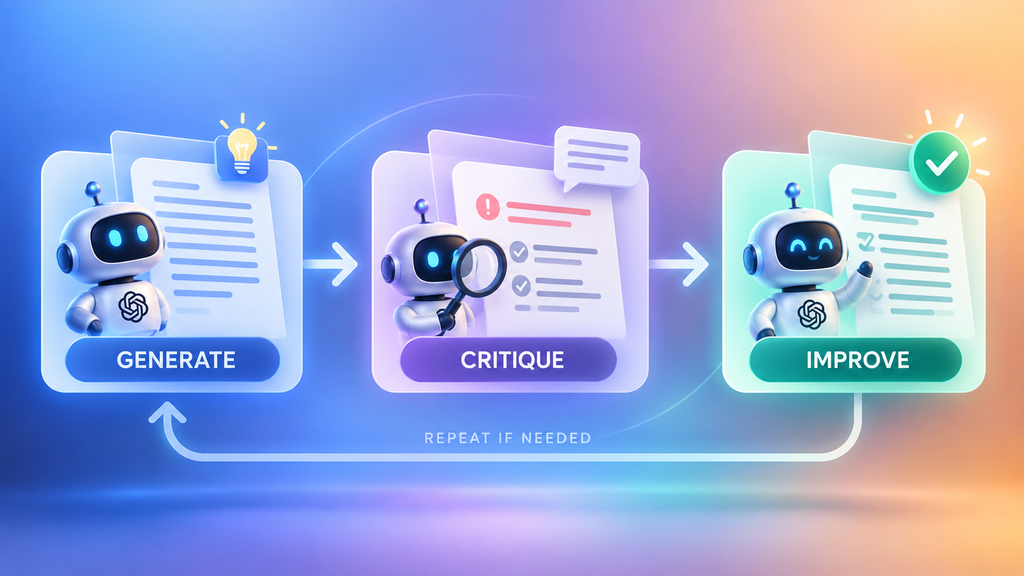
Self-reflection can improve an AI response, but each iteration is only as reliable as the feedback entering the loop.
Suppose you ask an AI to prepare a short research memo about a startup.
The model writes that the company raised $40 million in its latest funding round. The writing is good, but the number is wrong.
You then ask:
“Review the memo carefully. Check for factual mistakes and improve anything that looks unreliable.”
The model rereads the answer.
It may soften the wording around the investment. It may reorganize the funding paragraph. It might even add a sentence explaining what the capital will be used for.
And the $40 million figure may remain exactly where it was.
Why? Because nothing entered the system that could prove the number wrong.
The original answer and the critique are drawing from the same context. The same missing source remains missing. The same mistaken assumption can shape both the answer and the review.
The revised version may therefore become more persuasive without becoming more accurate.
That is one of the more dangerous forms of AI error because poor writing usually makes us cautious. Polished writing does the opposite.
A mistake that survives three rounds of editing no longer looks like a mistake. It starts to look considered.
The weakness is often in the critique, not the rewrite
Once an AI receives useful feedback, rewriting is often the easy part.
The difficult step is generating feedback good enough to deserve trust.
A 2024 critical survey in Transactions of the Association for Computational Linguistics reached a striking conclusion after examining the field: on general tasks, there was little reliable evidence that simply prompting LLMs to critique themselves consistently produced successful self-correction. The results were much stronger when the model could use reliable external feedback such as code execution, retrieved knowledge, human feedback or another verifiable signal.
That helps explain a familiar interaction.
Ask an AI, “Can this paragraph be improved?” and it will almost always find something.
The introduction could be stronger.
The structure could be clearer.
The argument could use more context.
These may be reasonable editorial comments. But none of them answers the harder question:
Is the central claim true?
This is where shallow critique becomes easy to mistake for deep evaluation.
The model can improve what it can see: wording, ordering, clarity, repetition and presentation. It has a much harder time discovering a missing piece of reality simply by looking harder at its own answer.
Richard Feynman captured the human version of this problem decades before language models existed:
“The first principle is that you must not fool yourself and you are the easiest person to fool.” – Richard Feynman
AI systems face a surprisingly similar challenge. A system judging its own reasoning can inherit the assumptions that produced the reasoning in the first place.
Critiquing somebody else may actually be easier
Recent research makes this even more interesting.
ReflecTool-Bench, published in 2026, tested 12 models across 968 multi-turn dialogues involving 88 APIs and ten domains. Researchers compared two situations: models diagnosing mistakes in an existing dialogue, and models identifying and repairing mistakes that they themselves had made earlier.
Performance dropped when the task moved from critique to self-reflection. Models were also better at recognizing errors introduced by users than errors originating from the assistant itself.
That is an important distinction.
A model may be quite good at telling you what is wrong with an answer placed in front of it.
That does not automatically mean it is equally good at recognizing the flaw in reasoning it has already committed to.
Humans know a version of this problem too. It is easier to spot the gap in somebody else’s argument than the assumption buried inside our own.
So should we stop asking AI to check its work?
No. That would throw away something genuinely useful.
The generate → critique → improve workflow works particularly well when the task gives the model a way to test its criticism.
The difference is easy to see in code.
Imagine an AI writes a function that should sort customer records by date. On reflection, it reads the code and says everything looks correct.
That opinion is useful, but weak.
Now run a test case.
The output puts March 10 before February 8.
Suddenly the model has something much better than its own confidence: evidence of failure.
The next critique is no longer:
Do I think this looks right?
It becomes:
Why did this code fail this test?
That change may sound small. It is the difference between introspection and verification.
The same principle works elsewhere.
For mathematics, let the model use a calculator or execute code rather than repeatedly reconsidering arithmetic in prose.
For research, give it the primary documents and ask it to attach every important claim to evidence.
For financial analysis, check figures against filings or an authoritative dataset.
For factual writing, search for contradictory evidence rather than asking only whether the existing paragraph “looks accurate.”
For an AI agent taking actions, inspect tool results and system state instead of trusting the agent’s description of what it believes happened.
Reflection becomes much more valuable when reality gets a vote.
The prompt matters too
A generic prompt such as:
Check your answer and make it better.
invites generic feedback.
A stronger prompt gives the model an actual job to perform during the critique.
For example:
Review the answer claim by claim. Separate factual claims from interpretation. For every factual claim, identify the evidence supporting it. Flag anything you cannot verify rather than filling the gap from memory.
Or:
Try to disprove the conclusion. Identify the three assumptions that would make it wrong. Check each assumption against the available sources before revising.
For numerical work:
Recalculate every figure independently. Do not reuse the calculations from the first response. Show which inputs were used and flag any missing data.
For research:
Compare the answer against the primary source. List any statements that go beyond what the source establishes, then revise only after completing that check.
These prompts are stronger not because they contain more words, but because they give the critique clear evaluation criteria.
Instead of asking,“Is this good?”, you are asking questions that can produce evidence.
There is another useful tactic: separate the jobs.
The model that wrote the first answer does not always need to be the only judge of that answer. You can ask another model or another independent run to evaluate it without seeing the original reasoning. For important work, human review remains valuable precisely because the reviewer can bring knowledge and assumptions that were not present in the original loop.
None of these methods guarantees correctness.
They simply reduce the chance that every stage is looking through the same blind spot.
More iterations are not automatically better
There is also a temptation to treat reflection like depth:
If one revision helps, five revisions must help more.
That is not necessarily true.
Each round costs tokens, time and money. Worse, later iterations may begin optimizing things that were never the real problem.
The first pass fixes an unclear explanation.
The second improves the structure.
The third changes the headings.
The fourth rewrites the introduction.
The fifth makes the language more confident.
Meanwhile, the unsupported claim in paragraph six survives all five versions.
At that point, the system is not reasoning more deeply. It is polishing around uncertainty.
A useful reflection process therefore needs a stopping rule.
Ask whether something new entered the process.
Was a new source consulted?
Did a test run?
Was a calculation independently recomputed?
Did another reviewer challenge the premise?
Did the evidence change?
If the answer is no, another rewrite may have diminishing value.
A better workflow is slightly less elegant
The attractive AI loop is beautifully simple:
generate → critique → improve
Keep it. It is a useful workflow.
Just do not let it become a closed circle.
For work where correctness matters, the fuller version should look more like this
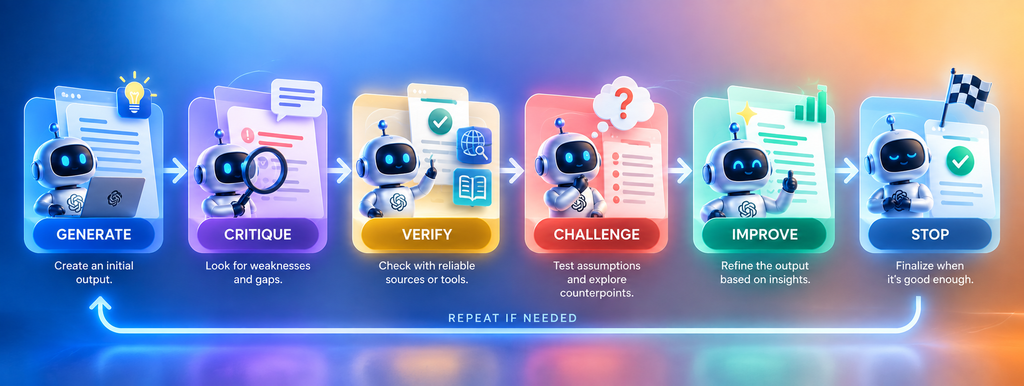
The verification step may be tiny. Sometimes it is a calculator. Sometimes a test suite. Sometimes one primary document. Sometimes a person who knows the subject well enough to say, That assumption is wrong.
That small interruption is often what prevents the model from turning its first mistake into a polished final answer.
There is a good reason the original three-stage workflow feels natural. Humans work that way too. Writers edit drafts. Engineers review code. Researchers revisit conclusions.
But serious human work also developed something beyond self-reflection: experiments, peer review, citations, reproducible calculations, audits and independent checks.
We learned that thinking harder is useful, but not always sufficient.
AI systems are arriving at the same lesson.
The valuable model will not simply be the one that can generate an answer, criticize it and rewrite it indefinitely.
It will be the one that can recognize when its own reasoning has reached the edge of what it knows and knows where to look next.


