Anthropic launched Claude Opus 5.5 on September 22, 2026, as the first model in its Claude 5.5 family. It costs $4 per million input tokens and $20 per million output tokens, supports a 1 million-token context window, and can produce up to 128,000 output tokens in normal use.
Those specifications tell only part of the story.
Anthropic says Opus 5.5 costs roughly 40% less than Opus 5 on typical workloads at default settings, despite its basic input and output token prices falling by only 20%. The remaining difference comes from cheaper cache access and, on Anthropic’s tests and early deployments, completing work with fewer tokens and steps.
For developers building long-running agents, that makes the most useful question less “How much does one token cost?” and more:
How much does it cost to finish the task?
Claude Opus 5.5 at a glance
| Specification | Claude Opus 5.5 |
|---|---|
| Release date | September 22, 2026 |
| Model ID | claude-opus-5-5 |
| Context window | 1M tokens |
| Max standard output | 128K tokens |
| Batch max output | 300K tokens, beta |
| Input | $4 / MTok |
| Output | $20 / MTok |
| 5-minute cache write | $5 / MTok |
| 1-hour cache write | $8 / MTok |
| Cache read | $0.20 / MTok |
| Batch API | 50% discount |
| Reasoning | Adaptive, always on |
| Default effort | Medium |
| Knowledge cutoff | June 2026 |
Anthropic lists Opus 5.5 as active on the Claude API, Amazon Bedrock, Google Cloud, Microsoft Foundry and Claude Platform on AWS.
What actually changed from Claude Opus 5?
The clearest difference is not context length. Both generations target long-running, complicated work.
It is how much that work costs and how the model reasons while completing it.
| Feature | Opus 5 | Opus 5.5 | Change |
|---|---|---|---|
| Input | $5 / MTok | $4 / MTok | -20% |
| Output | $25 / MTok | $20 / MTok | -20% |
| Cache read | $0.50 / MTok | $0.20 / MTok | -60% |
| 5-min cache write | $6.25 / MTok | $5 / MTok | -20% |
| Default effort | High | Medium | Changed |
| Thinking | Could be configured | Always adaptive | Breaking change |
| Context | 1M | 1M | Same |
| Max output | 128K | 128K | Same |
Anthropic says Opus 5.5 also generates output more than 30% faster than Opus 5.
The most striking number in that table is not $4. It is $0.20.
Why cache pricing may matter more to AI agents than headline token pricing
Agentic workloads repeatedly revisit the same context: source files, tool definitions, instructions and conversation history.
Anthropic says long Claude Code sessions spend much of their input usage on cached context. That makes the 60% reduction in cache-read pricing disproportionately important for longer-running workflows.
Anthropic gives a useful example: at 120,000 tokens of context, a five-minute cache write on Opus 5.5 costs about $0.60, while reading that same cached context costs around $0.02. One write therefore costs roughly as much as 25 cache reads.
That changes the economics of keeping an AI agent working inside one large context.
Cost illustration
Using Anthropic’s official list prices:
| Example workload | Opus 5 | Opus 5.5 | Difference |
|---|---|---|---|
| 100K fresh input + 10K output | $0.75 | $0.60 | -20% |
| 100K fresh + 2M cached + 50K output | $2.75 | $1.80 | ~-35% |
| 100K fresh + 100K output | $3.00 | $2.40 | -20% |
Important: These are TLM calculations from Anthropic’s published token rates. They deliberately assume the same number of tokens on both models and exclude cache-write charges.
That means they do not include Anthropic’s second claimed advantage: Opus 5.5 can sometimes finish work using fewer steps and tokens.
Anthropic itself cautions that the saving varies heavily by workload and recommends measuring actual sessions rather than assuming a universal 40% reduction.
Claude Opus 5.5 price reductions vs Opus 5
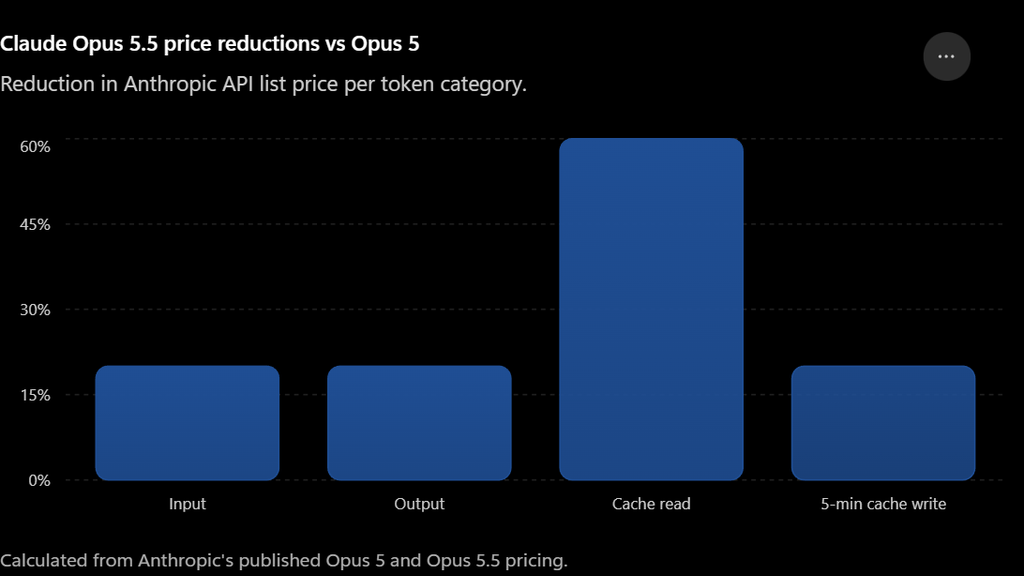
For the TLM CMS, recreate this graphic as an original chart rather than screenshotting Anthropic’s design.
Official visual reference: Anthropic’s Opus 5.5 pricing and benchmark page
Anthropic also published a dedicated cost explainer with official figures and interactive examples: What a task costs on Opus 5.5
The benchmark story needs one major caveat
Anthropic reports substantial gains across agentic coding, professional work and computer use.
| Official evaluation | Opus 5.5 | Opus 5 |
|---|---|---|
| Terminal-Bench 4.0 | 66.4% | 52.3% |
| FrontierCode v1.1 | 54.4% | 48.0% |
| CursorBench 4.0 | 57.8% | 46.6% |
| GDPval-AA v2.1 | 1,846 Elo | 1,708 Elo |
| AutomationBench | 40.0% | 26.9% |
| OSWorld 2.0 | 81.8% partial | 74.0% partial |
These are Anthropic’s published results and include different evaluation conditions depending on the benchmark.
But Anthropic makes an unusually important qualification itself: “benchmark margins have become a less reliable guide to real-world differences.”
That is why TLM should not build the entire article around “Opus 5.5 beats X.”
A stronger interpretation is that the model’s real commercial value depends on the combination of:
task quality + number of steps + tokens consumed + elapsed time + retries required.
Anthropic’s own coding examples reinforce that framing. In one test, Opus 5.5 audited and fixed a 200,000-line codebase in under three hours, while Opus 5 took more than 20 hours and used 2.5 times as many tokens. Anthropic also reports that an HAProxy C-to-Rust translation completed in 9.5 hours on Opus 5.5 versus 12 hours using Fable 5.1 and cost 51% less. These remain Anthropic-run or Anthropic-reported evaluations rather than guarantees for every production workload.
Opus 5.5 is not simply a drop-in model-name replacement
This deserves its own section because it serves a completely different Google query cluster:
Claude Opus 5.5 migration
Opus 5.5 API changes
Opus 5.5 thinking disabled
Opus 5.5 tool_choice error
Anthropic documents several behavioral and breaking changes.
| Migration issue | What changes in Opus 5.5 | Developer action |
|---|---|---|
| Thinking | Cannot be disabled | Remove old enabled/disabled thinking config |
| Effort | Default is now medium | Explicitly retest effort levels |
| Forced tool use | Certain tool_choice modes are unsupported | Move to auto with strict tool use |
| Thinking blocks | Bound to model and conversation | Preserve correctly when continuing sessions |
| Progress text | Can arrive in thinking blocks | Configure thinking.display if needed |
| Computer use | Older tool version unsupported in some environments | Migrate to current toolset |
| Safety refusal | Can return HTTP 200 with refusal details | Handle stop_reason: "refusal" |
Always-on thinking changes how developers should think about cost
Opus 5.5 uses adaptive thinking and does not allow reasoning to be disabled.
Developers instead control how much reasoning the model applies using effort.
Anthropic documents low, medium, high and xhigh, with max available for a single session in Claude Code. The default for Opus 5.5 is medium.
The important economic consequence is easy to miss:
thinking tokens count as output.
So a higher effort level can consume more billable output even when the final visible answer is short. Anthropic recommends rerunning effort sweeps rather than carrying an Opus 5 setting directly into Opus 5.5 because the newer model may reason differently at the same named effort level.
That creates a new optimization problem:
The cheapest setting is not necessarily the lowest effort setting.
It is the setting that reaches an acceptable result with the fewest total failed attempts.
Standard, Fast or Batch: three different economics
Instead of burying these options in paragraphs, make them immediately comparable.
| Mode | Pricing | Best suited to |
|---|---|---|
| Standard Opus 5.5 | $4 input / $20 output | Interactive agent and knowledge work |
| Fast Mode | $8 input / $40 output | Latency-sensitive work |
| Batch API | $2 input / $10 output | Asynchronous jobs where immediate response is unnecessary |
Fast Mode can run at up to 2.5× normal speed, according to Anthropic. Batch processing receives a 50% discount on standard input and output pricing.
This table is strong for both normal search and generative queries such as:
“What is the cheapest way to use Claude Opus 5.5?”
The answer is not universally “Batch.” It depends on whether the application can tolerate asynchronous processing.
A 1M context window does not make every 1M-token session economical
Opus 5.5 supports one million tokens of context, 128K normal output and up to 300K output through the Batch API in beta.
But context size and context economics are different things.
An application repeatedly sending hundreds of thousands of unchanged tokens without effectively using caching can spend significantly more than one maintaining a high cache-hit rate.
Anthropic explains that Claude Code caching is prefix-based. Changes to early parts of the request, such as system prompts or tool definitions, can invalidate substantial portions of the cache. A steady conversation that mostly appends new information is better positioned to preserve cache hits.
This gives developers another metric worth watching beyond context-window size:
cache-hit rate.
That is a much more useful production question than simply asking whether the model “supports one million tokens.”
What Anthropic says about safety
Anthropic describes Opus 5.5 as its strongest model so far on its automated behavioral audit.
The company says the model is less likely than recent Claude models to take difficult-to-reverse actions or move outside defined boundaries, while showing stronger resistance to prompt-injection attacks across coding, tool use, web browsing and computer use.
For agent deployments, Anthropic also describes a stack that includes action screening, sandboxing and security-oriented code review.
But this section should not turn into marketing copy.
Anthropic’s own launch material notes that alignment testing still has limits. That is particularly relevant for long-running autonomous work, where a model can encounter combinations of tools, instructions and environments not represented in controlled evaluations.
For TLM, that is the useful takeaway:
stronger measured safeguards do not eliminate the need for application-level permissions, monitoring and fallback behavior.
Where can developers use Claude Opus 5.5?
Anthropic officially lists the model on:
- Claude API
- Amazon Bedrock
- Claude Platform on AWS
- Google Cloud
- Microsoft Foundry
The direct API model identifier is claude-opus-5-5.
This section should remain short because its job is primarily to satisfy navigational and GEO queries.
The production test that matters
Opus 5.5 gives developers a model with cheaper tokens, dramatically cheaper cache reads, stronger published benchmark results and a different reasoning model.
None of those numbers alone proves that migrating an application will cut its bill by 40%.
Anthropic itself recommends comparing real workloads. Its Claude Code cost guidance tells users to examine actual /usage output and compare sessions rather than relying on one universal estimate.
For teams evaluating Opus 5.5, the useful scorecard is therefore:
completion rate → total turns → tool calls → output tokens → cache-hit rate → elapsed time → retries → total cost per accepted result.
That is also the larger shift behind Opus 5.5.
The frontier-model race is becoming less useful to understand through price per million tokens alone. For agents that can spend hours touching files, calling tools and revisiting context, the more valuable unit is increasingly: cost per useful piece of completed work.
And that is where Opus 5.5 now has to prove Anthropic’s efficiency claims outside the benchmark harness.

