Knowing that a growing region is getting hotter is not yet a procurement decision.
A food manufacturer needs to know whether that heat threatens the specific crop variety it buys, which supplier and contract are exposed, whether quality specifications are likely to become harder to meet and whether there is still time to sample differently, secure another origin or buy earlier. Finches is building its software around that distance between a warning and an action.
The Bavaria-based startup has closed a €2 million pre-seed round led by High-Tech Gründerfonds, with Vanagon Ventures as co-lead. Bayern Kapital joined as a new investor, while UnternehmerTUM Funding for Innovators and existing industry and technology angels invested again. Finches says the capital will support product development and a broader sales push.
That funding arrives only weeks after Finches Intelligence went live in September 2026, but the company is making an important distinction about what the product actually predicts. Finches does not attempt to produce another generalized crop-yield forecast. Instead, it builds a working model of what an individual manufacturer buys: raw materials, origins, suppliers, specifications and contracts. External signals are then interpreted against that commercial context.
The external layer spans weather forecasts, satellite imagery, soil information, crop science, pests and disease, market data, tariffs, regulation and local-language news. The internal side can include procurement history, contracts, lab results and field observations. An alert is therefore intended to answer something more specific than where is agricultural risk increasing? It should identify which part of the buyer’s own supply base now needs attention.
Finches Field provides the ground-level part of that system. Agronomists can record farm visits by voice, photos and notes even without connectivity, after which the observations are converted into structured records associated with a plot, supplier, variety and season. Those records can then sit beside wider regional signals rather than remaining in notebooks, phone calls or WhatsApp threads.
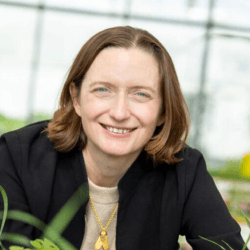
The architecture reflects CEO Catharina van Delden‘s original problem more closely than a conventional supply-chain dashboard. She also manages her family’s pecan farm in Uruguay and says crop trouble can become visible months before the buyer eventually feels the shortage. Her summary of the founding idea is concise: “Closing that gap between knowing and acting is why we started Finches.”
Van Delden previously founded innovation-management software company innosabi, which was sold in 2021. CTO Dr. Stefanie Glenn brings a Cambridge genetics PhD and previous data and AI leadership experience at Google and BMW. Alexandra Vázquez Bea, who joined as co-founder and CFO/COO in January 2026, previously held leadership positions at Oetker Digital and served as CFO of Veganz during its IPO.
The timing has made the company’s thesis easier to test. Europe’s 2026 heat and drought reduced the June-to-September forecast for European grain production by 16.7 million tonnes, according to an Energy and Climate Intelligence Unit analysis of COCERAL forecasts, with the lost output valued at about €3.2 billion. Separately, World Weather Attribution found that western Europe’s April-to-June soil drought had become roughly five times more likely in today’s climate, while the exceptionally high evaporative demand was around 80 times more likely.
The important commercial question is whether Finches can turn that kind of climate information into decisions at a level broad weather-risk systems usually do not reach. Its product documentation describes a model that works down to suppliers, crop varieties and contracts, rather than stopping at a country or region. Finches also says its platform can be used without an initial system integration, with SAP, laboratory and other connectors added later.
Finches currently sells the core platform as an annual license tied partly to how much a customer spends on agricultural raw materials, while its field application is priced per user. Premium alerting, system connectors, custom risk models and automated reports can be added separately. That pricing model is notable because it aligns the core subscription more closely with the scale of the sourcing problem than with a simple employee-seat count.
Public proof remains early. Finches says its initial users include a leading organic baby-food manufacturer and a North American Fortune 500 food group, but neither is publicly named. Finches Intelligence is also still being delivered through a capped Early Access Program. And although its hosting providers hold ISO 27001 and SOC 2 Type 2 certifications, Finches GmbH itself does not yet hold either, with the company publicly targeting the second quarter of 2027.
That gives the €2 million round a clear next test. The technology already has access to more agricultural signals than most sourcing teams can manually reconcile. What Finches now needs to demonstrate is that connecting those signals to a specific supplier and contract consistently creates better procurement decisions before the market, laboratory or failed delivery makes the problem obvious.
About Finches
Finches is a German AgriTech company founded in 2025 and headquartered in Wörthsee near Munich. Its sourcing-intelligence platform connects field observations, procurement records and external agricultural signals to help manufacturers identify raw-material risks earlier. Finches was founded by Catharina van Delden and Dr. Stefanie Glenn, with Alexandra Vázquez Bea joining as co-founder and CFO/COO in 2026.