An early tester did not ask his Dot to check whether he had forgotten to invoice anyone.
According to OpenAI, the agent noticed the missing invoice itself, prepared it, then sent it only after the user approved the action. It is a small example buried inside the Dots announcement, but it explains the product more clearly than the phrase “always-on AI agent” ever could.
ChatGPT has largely trained people to think in turns: you ask, the model responds, and the next move belongs to you. Dots change that rhythm. OpenAI wants the agent to retain the goal, keep watching the work around it and return when something has changed or a decision is required.
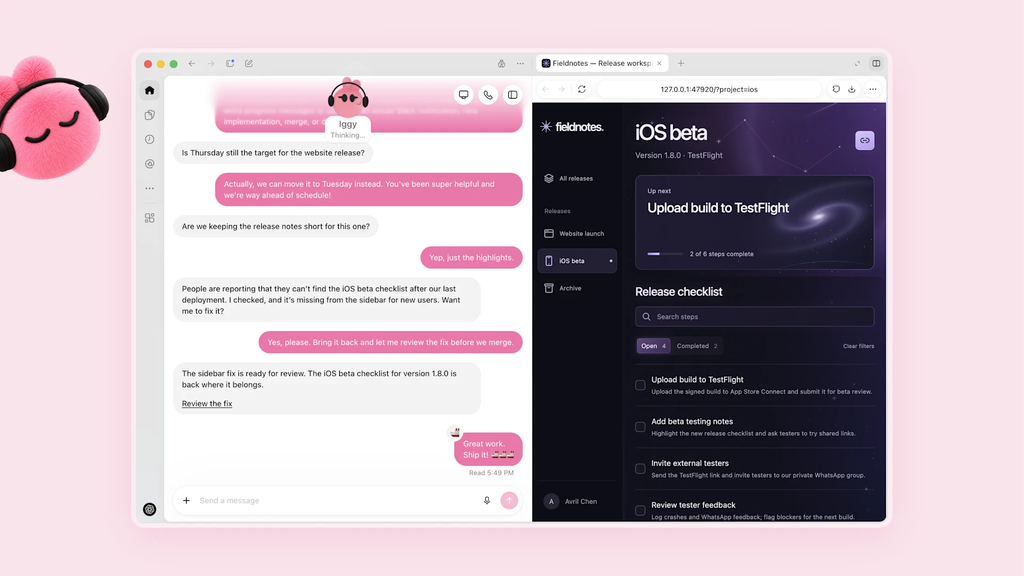
The company introduced Dots on September 29 as GPT-6 Astra-powered agents with their own cloud computer and browser. They can connect to more than 4,000 apps through OpenAI’s plugin ecosystem and remain reachable through ChatGPT, Slack, Microsoft Teams and voice. OpenAI says a Dot can manage several projects at once without forcing the user to maintain separate conversation threads or direct each step manually.
That sounds like a productivity upgrade until you look at the examples OpenAI chose.
For a developer, a Dot can watch customer feedback, identify recurring issues, build and test smaller fixes and return with completed pull requests. For a scientist, it can rerun analyses when new evidence arrives and update supporting figures. During a product launch, it can revisit materials when scope changes instead of waiting for somebody to remember that every related document also needs updating.
The common thread is not automation. Companies have automated tasks for decades.
What is different is continuity.
A traditional automation normally waits for a predefined trigger and follows a predefined path. A Dot is intended to understand an ongoing objective, notice relevant changes and decide that more work may be required. That gives it considerably more usefulness, but also considerably more room to be wrong.
OpenAI’s safety design reveals how seriously it takes that problem.
When a Dot performs what OpenAI calls “proactive research” in the background, its connected-app tools are restricted to read-only access. It can look for information, but those tools cannot send messages, modify app content or take control of the browser or computer. Users decide which apps a Dot can access, while Custom Rules can allow an action, block it or require approval. Higher-impact actions are checked through OpenAI’s auto-review system, and some sensitive operations, including changing a password, remain with the user. OpenAI also explicitly cautions that Dots can make mistakes and that consequential work should be reviewed.
That separation is important because Dots create a product problem that ordinary chatbots largely avoid. When an answer is wrong, a person can ignore it. When an agent is wrong while acting, the consequences can leave the chat window.
OpenAI therefore appears to be building Dots around a compromise: let the agent carry more responsibility, but separate observing from acting and keep higher-consequence decisions behind permissions, reviews or the user.
The company’s enterprise plans push that idea further.
OpenAI is previewing specialist Dots that companies can provision with their own identity, credentials and access to selected systems. Rather than helping one person with a mix of tasks, these agents are designed around a defined organisational responsibility. OpenAI says it has already explored the model internally across procurement, invoice processing, email marketing, customer support and commercial contracting, and will begin with focused enterprise pilots. It is also working with Microsoft to integrate specialist Dots with governance and security controls in Microsoft Agent 365.
The distinction is worth watching. Software has traditionally been licensed to employees. Specialist Dots suggest a future in which organisations may instead provision an AI identity to perform a particular function, deciding which systems it can enter and which actions still require a person.
For now, the rollout is narrower. Dots are beginning to reach ChatGPT Pro and Business Premium users in eligible markets, while Enterprise customers, including eligible Edu and Healthcare workspaces, can access the beta when an administrator enables it. OpenAI says the first Dot is included with Pro and Business Premium at no additional cost, with the possibility of adding more Dots later.
The interesting question is therefore not whether Dots are a more powerful version of ChatGPT.
It is whether people are comfortable moving from asking AI to complete tasks to giving an AI responsibility for noticing when those tasks need to happen at all.
The forgotten invoice is a modest example. But if that behavior extends reliably to engineering, research, sales and operations, the next interface for AI may not begin with a prompt.
It may begin with something you forgot to ask.


