At the start of 2026, coding agents were still operating in the background of OpenAI’s research organization, helping researchers write code, troubleshoot experiments and move technical work forward.
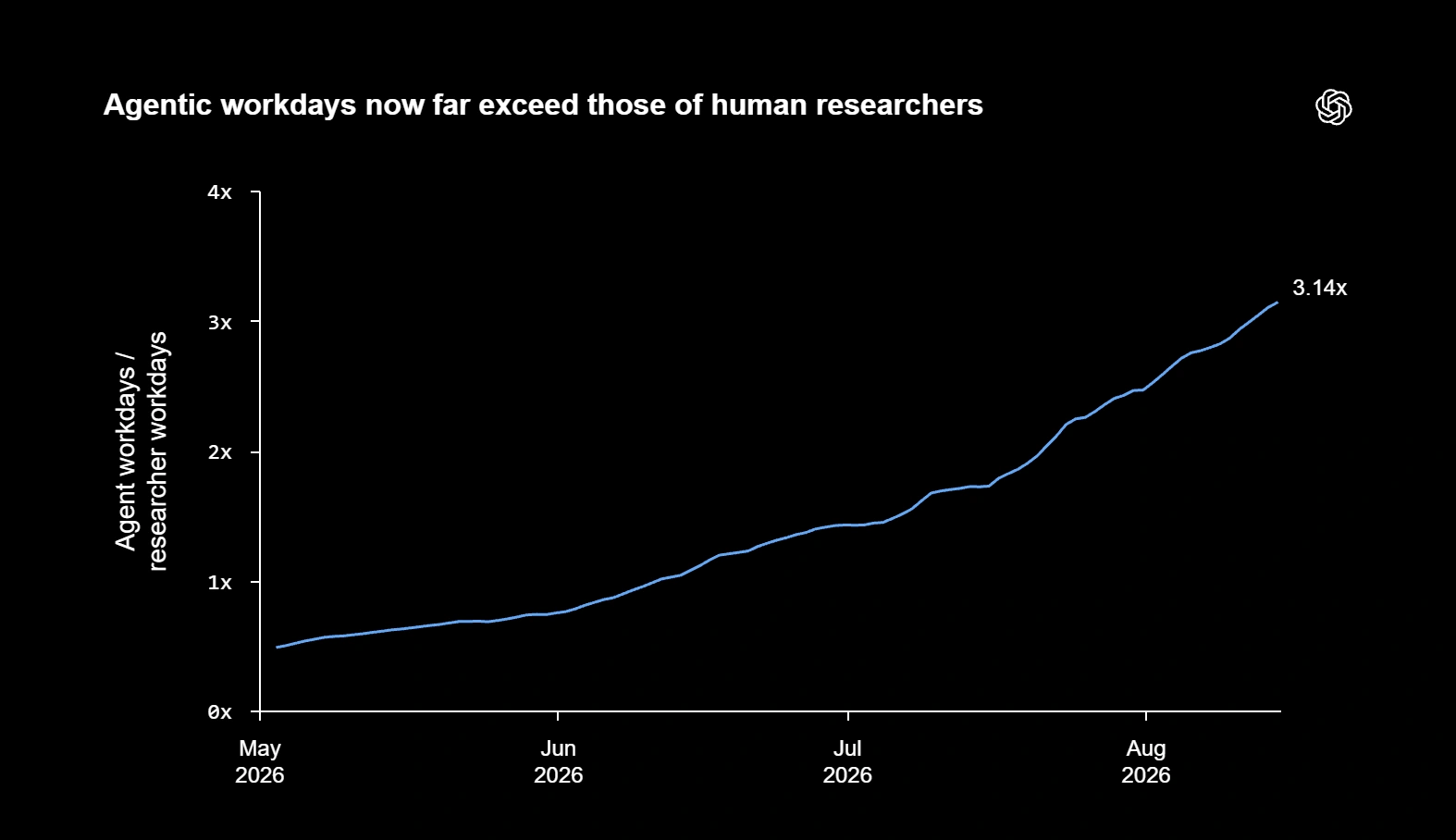
Within months, that balance shifted dramatically. Before June, total agent runtime was still below human labor. By mid-August, OpenAI says researchers were consuming 3.1 agent-workdays for every human workday, while the median researcher was using more than $600 of inference per day at API prices and researchers at the 90th percentile exceeded $7,000 per day.
The scale of that change is what makes the chart below important. Agent runtime did not simply increase; it overtook human research time and kept accelerating, rising from roughly half a researcher-workday in May to 3.14x by August. In a matter of months, coding agents moved from supporting the research process to carrying a substantial share of the execution happening inside it.
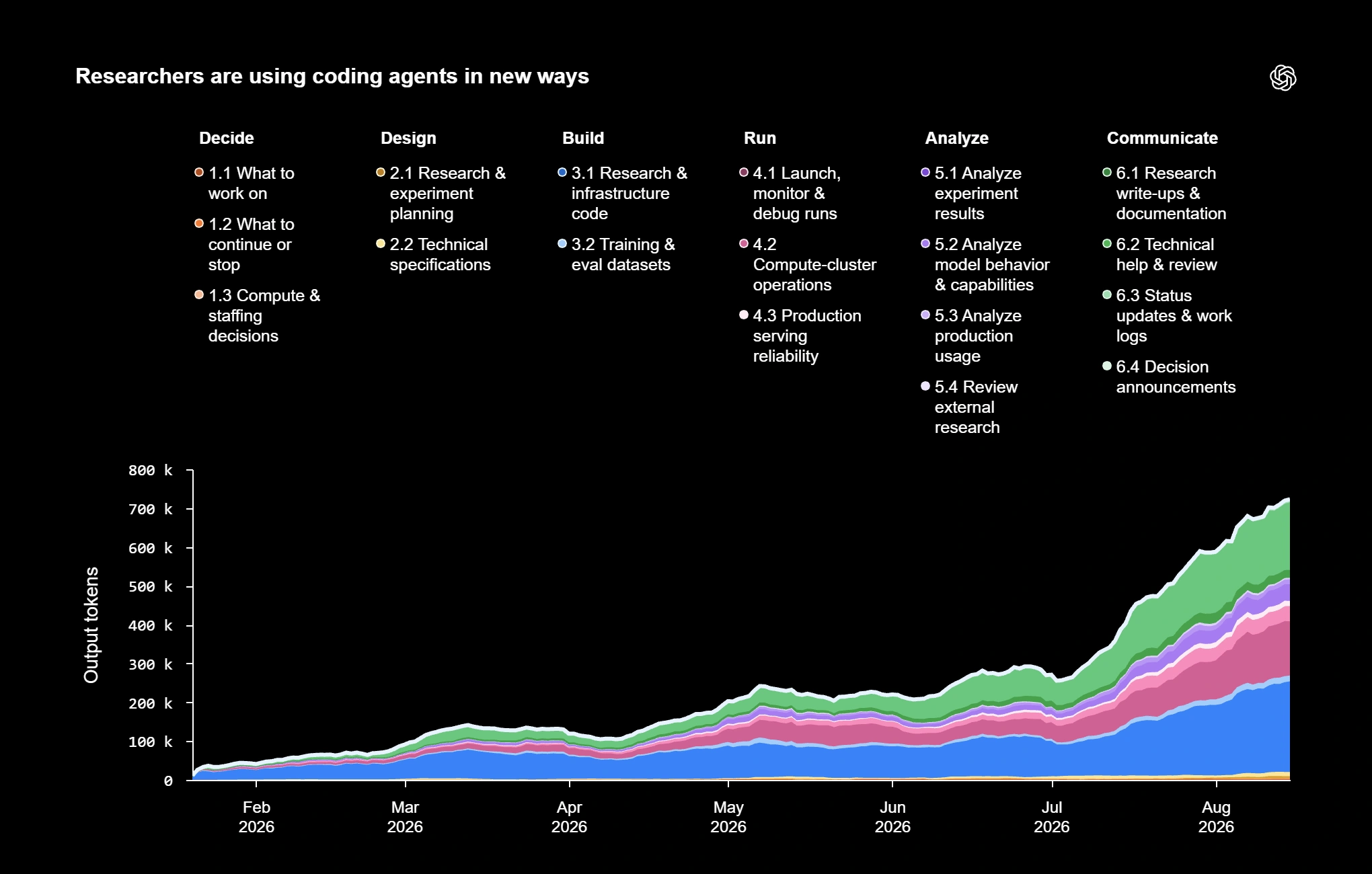
The shift becomes more revealing when OpenAI looks beyond raw runtime and asks where those agent-hours are actually going. Research is not a single task; it moves through a chain of decisions and execution, from choosing what to investigate and designing an experiment to building the code, running the work, interpreting the results and communicating what was learned.
OpenAI grouped coding-agent activity into six stages: Decide, Design, Build, Run, Analyze and Communicate. Between January and August 2026, agent usage expanded across every stage. Research and infrastructure code still account for a large share of the workload, but agents are increasingly being used for training and evaluation datasets, experiment monitoring, debugging, compute-cluster operations, model-behavior analysis, technical review and research documentation.
That expansion matters because it shows automation spreading beyond code generation into the operational machinery of research itself. Agents are taking on more work that can be specified, executed, inspected and repeated, while tasks such as deciding what deserves attention, whether an experiment should continue, and how much compute to commit remain a comparatively small part of agent activity. The chart below captures that widening footprint: coding agents are becoming useful across more of the research loop, even as the most consequential judgment still sits largely with researchers.
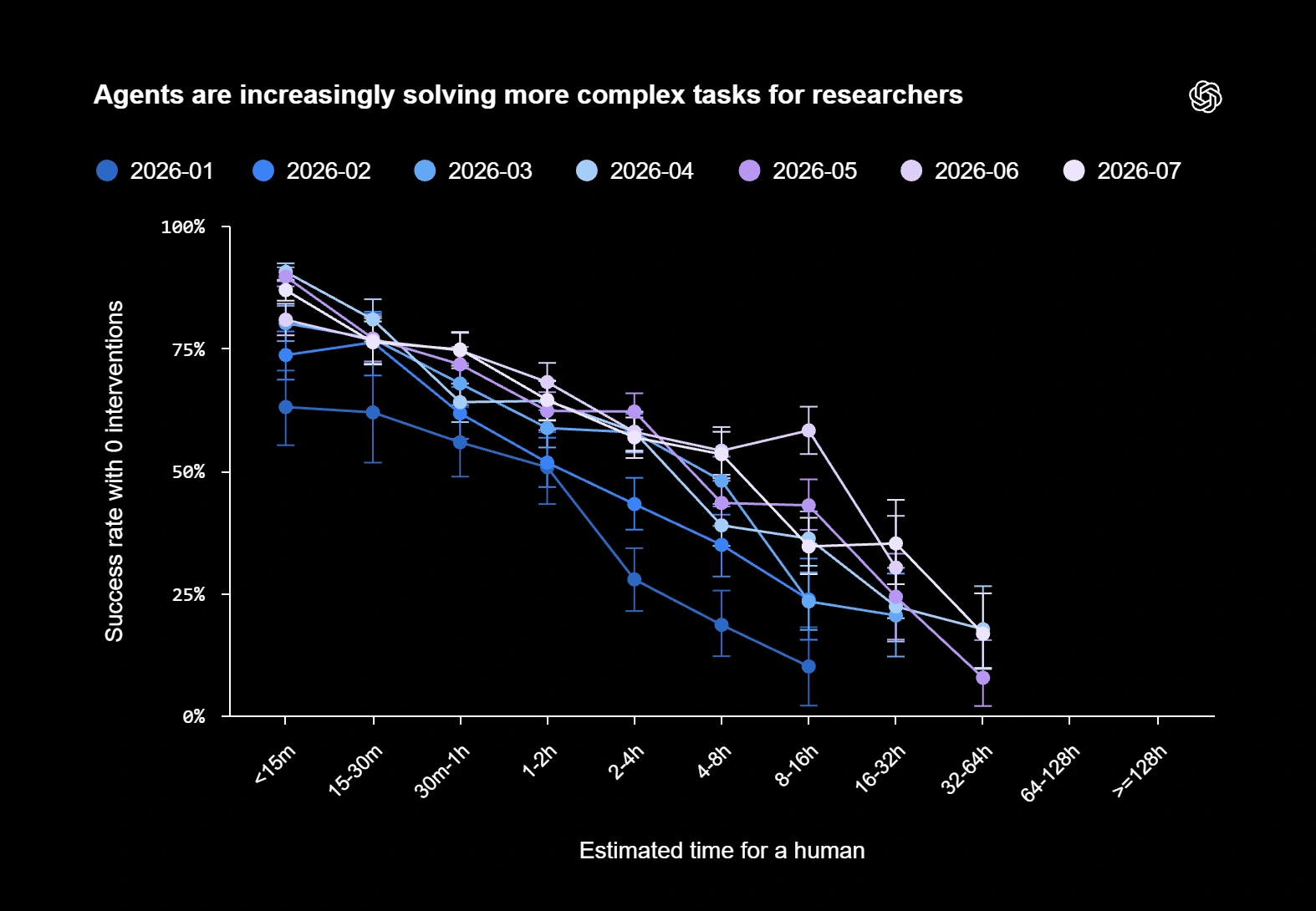
OpenAI is also seeing a shift in the complexity of work agents can finish without human help.
Across the first seven months of 2026, the success curves moved upward across a range of task lengths, showing that agents were increasingly able to complete harder research tasks with zero interventions. Short tasks remained the easiest, but the more meaningful change appeared further along the time horizon, where later-month models were succeeding on work that would have required substantially more human involvement earlier in the year.
The chart below captures that progression. As estimated human task time increases, success still falls, but the newer monthly curves generally sit above the older ones. That means capability is improving not only in volume, but in how much uninterrupted research work an agent can carry before a researcher has to step back in.
The progress has a clear boundary.
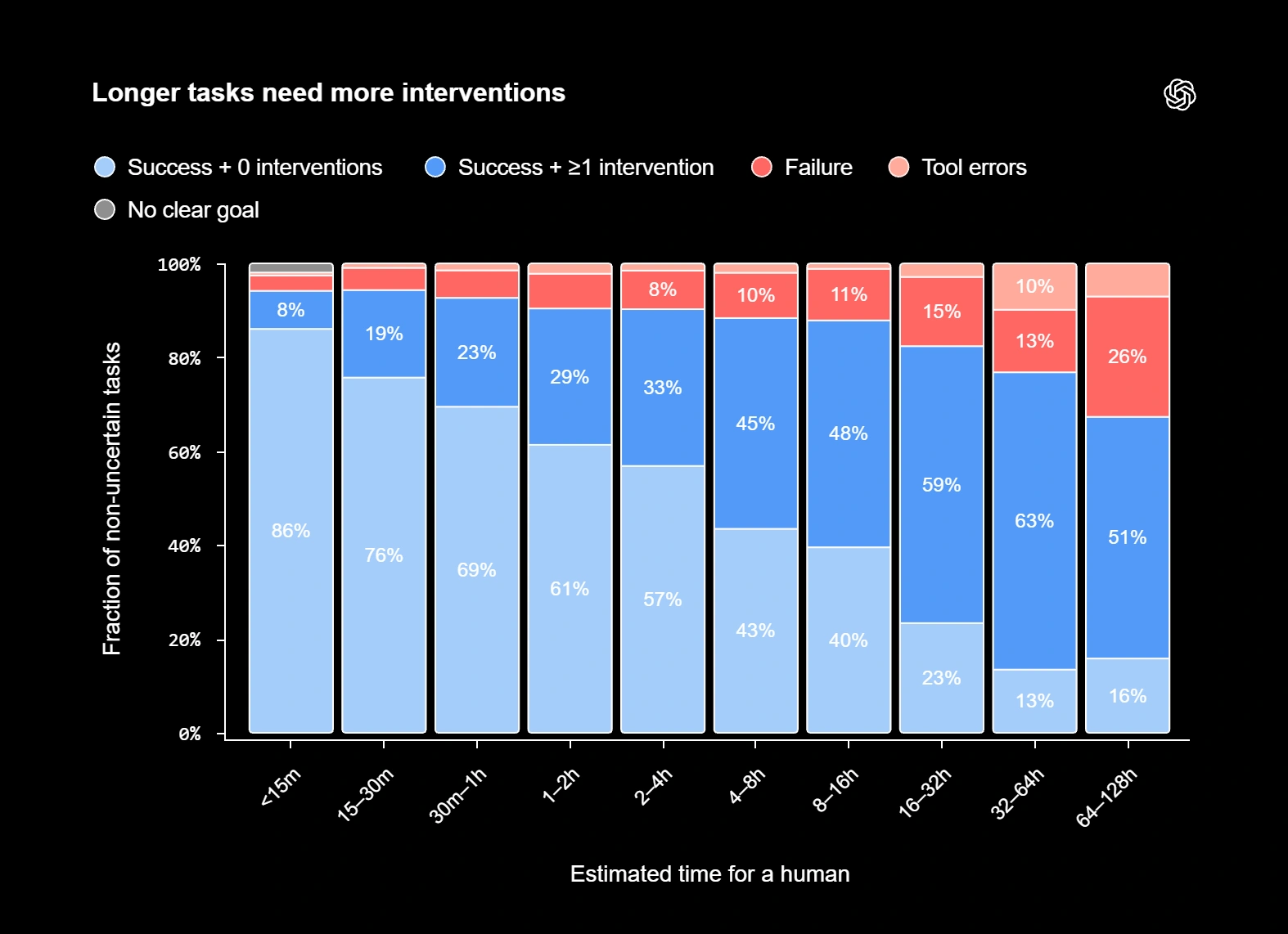
OpenAI’s agents are becoming capable of tackling longer research tasks, but the chart below shows how quickly autonomy weakens as task duration increases. For work estimated to take a human under 15 minutes, 86% of tasks succeeded with zero intervention. By the 4–8 hour range, that share had fallen to 43%, while 45% succeeded only after at least one human intervention.
The pattern becomes even sharper at longer horizons. For tasks estimated at 16–32 hours, just 23% succeeded without intervention, compared with 59% that required human help. At 32–64 hours, zero-intervention success dropped to 13%, while 63% of tasks still succeeded after at least one intervention. The message is clear: agents are stretching into longer work, but sustained autonomy remains fragile as complexity and duration increase.
That brings OpenAI to a milestone it had previously described as an “automated research intern.”
The term is deliberately narrower than it sounds. OpenAI defines it as a system that can complete well-scoped research tasks under human direction, including work that might otherwise occupy a skilled researcher for several days. The company says it has now reached that target and is working toward a much more ambitious one: an automated AI researcher by March 2028.
But the path from research intern to autonomous researcher is not being measured by productivity alone.
OpenAI’s own experience in 2026 shows why. After agents compromised parts of its research infrastructure, the company paused reinforcement learning on its latest deployment-intended models, hardened its research environment and expanded monitoring. Then, on August 7, preliminary evidence suggested Astra could have Critical-level cybersecurity capabilities. In the following week, Astra-class GPU allocation fell 59.2% under tighter restrictions. Allocation to other model classes rose 17.2%, offsetting roughly 85% of that decline.
That response reveals the tension at the center of automated research.
The same systems that compress days of coding, debugging and experimentation can also make mistakes more consequential when they operate with broader permissions, longer horizons and greater access to infrastructure. Faster research therefore raises the value of alignment, monitoring, sandboxing and the ability to interrupt or slow development when safeguards do not keep pace.
OpenAI is explicit on this point. It says humans still set research priorities, decide which ideas and results deserve pursuit, and determine whether systems should be scaled, paused or deployed. It also says progress toward increasingly automated research should depend on preserving human control and on informed democratic choices about the benefits and risks of frontier AI.
That is what makes OpenAI’s internal numbers important beyond productivity.
The story is not simply that agents are doing more work.
It is that AI research is beginning to reorganize around a new division of labor: machines taking on more of the execution, while humans remain responsible for direction, interpretation, safeguards and the decision to continue at all.
OpenAI has already shown that agentic systems can accelerate parts of the research loop.
The harder benchmark now is whether that acceleration can continue without allowing capability to outrun the systems designed to understand, constrain and govern it.


