The global power bank-sharing market was valued at $2.8 billion in 2025 and is forecast to grow at 14.7% per year. In the US, the market remains largely undeveloped: Ray estimates the country has between 5,000 and 10,000 stations in total, against demand for more than 300,000, roughly 3% of that potential.
New York, September 22, 2026 – Ray, a powerbank-sharing company, announced its launch in New York City, the launchpad for its expansion into the US market. The company is piloting 120 charging stations across Manhattan. Users rent a portable power bank by tapping a bank card, Apple Pay, or Google Pay at the station and return it to any other station in the network.
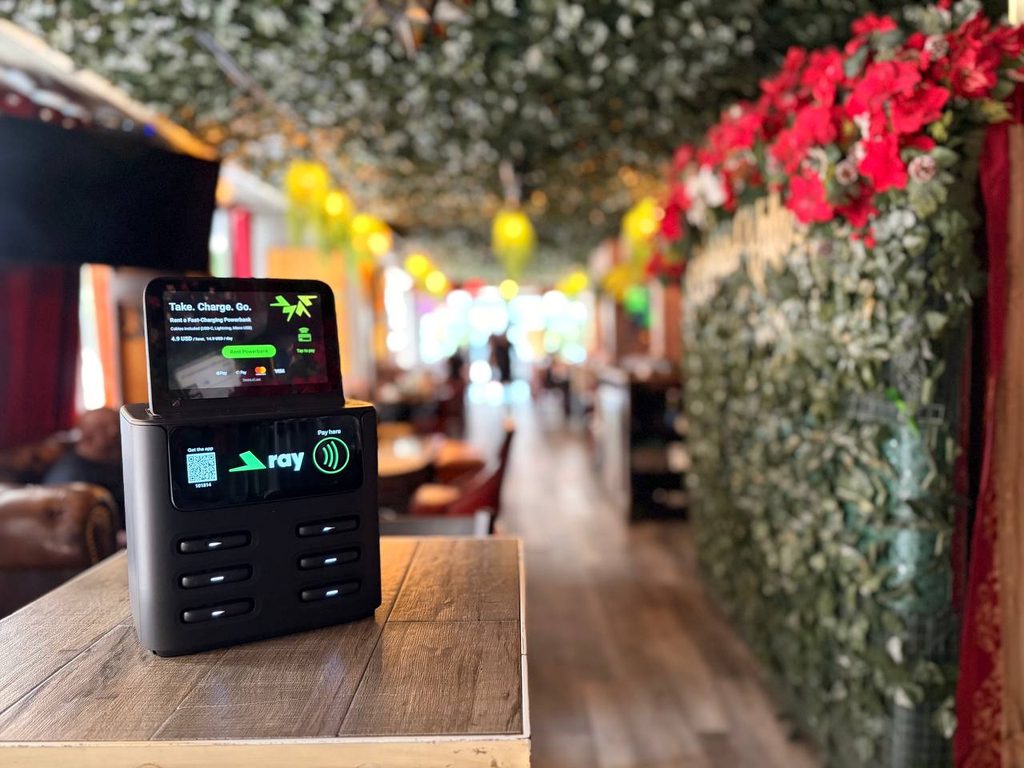
Founded in 2025 by Igor Kosolap and Roman Averianov, Ray operates charging stations in restaurants, cafés, gyms, and other public venues. The company launched in Dubai and Abu Dhabi in late 2025, raising a $1.2 million seed round, and says it is on track for profitability. Ray has raised a separate, undisclosed pre-seed round to fund the New York pilot. The company is also part of the current Grishin Robotics accelerator cohort, with its demo day on September 17, 2026.
New York is Ray’s first market in the US, thanks to its density, transit access, and visitor numbers. According to a recent report, the city drew 65 million visitors last year, generating $84.7 billion in economic impact. The NYC Department of Health’s restaurant inspection database lists around 31,300 food service establishments across the five boroughs, including roughly 12,500 in Manhattan.
Ray estimates about half meet its criteria on size, average bill, and having a dedicated dining room with seating; the network also covers gyms, hospitals, transit hubs, gaming venues, and hotel lobbies. The company puts the city’s eventual capacity at more than 20,000 stations.
New York has already treated charging as public infrastructure: the city’s LinkNYC network, which replaced old payphones with roughly 2,200 kiosks offering free Wi-Fi and USB charging, made that case years ago. Ray’s model extends the same idea into private venues, letting people grab a charged battery and keep moving instead of standing at a fixed kiosk.
“Other companies tried to build this before us. Between 2018 and 2019, several startups put most of their funding into building IT platforms, and COVID hit before they could scale the network itself. We get to start from a different place as our platform is already built and running in nine countries, so we can put all our focus into building out the charging network in the US,” said Roman Averianov, CEO Ray USA and co-founder of Ray
Shared mobility services such as bike and scooter rentals are now common in large US cities, and Ray sees that as evidence Americans are already primed for renting a power bank instead of carrying a cable. Separately, Americans start to feel anxious about their phone battery once it drops to an average of 38%, according to a recent survey of 2,000 US adults, even though most phones show a low-battery warning at 20%.
Igor Kosolap, co-founder of Ray and CEO of Ray Global, states, “We see huge potential in the US, with New York as our starting point. Based on our experience abroad, the market can support more than 300,000 stations against fewer than 10,000 today, it’s barely built, and we plan to change that.
Every our station runs on Tap-to-Pay: no app, just tap and pay with Apple Pay, Google Pay, or a card if your phone is dead, about 15 seconds instead of the usual two to three minutes. Pricing is simple too: you pay for an hour, and if the power bank isn’t returned in time, we charge for a full day – no subscriptions or hidden write-offs.“
Ray’s estimate comes from comparing station density across markets. China runs more than 6 million stations, or about 4.3 per 1,000 people, a level the company considers oversaturated. While the US currently sits at roughly 0.04 stations per 1,000 people, by the company’s count. Ray works off a rough benchmark of one station per 1,000 people for adequate urban coverage, which is how it arrives at its 300,000-station estimate for the US.
The company aims to become a leader in the New York market in one year and capture at least a third of the US market over time.
About company
RayPB is a US-based company building a powerbank-sharing network for urban environments and hospitality venues. The company launched its first US pilot in New York City in September 2026, following its debut in the UAE in November 2025, where it has since deployed more than 500 stations and is targeting market leadership with more than 1,300 active stations by the end of 2026. Ray’s network runs on an in-house platform, built by its own engineering team, that already powers powerbank-sharing services under multiple brands in nine countries.


