Artificial intelligence is moving deeper into engineering, and the next opportunity may lie in what happens after a product is designed. At the SOLIDWORKS 2027 launch in Ahmedabad on October 29, BEACON and Dassault Systèmes explored how AI-assisted design, automation, simulation and connected manufacturing systems could help engineers carry decisions from the CAD environment to the factory floor.
Tech Lens Media attended SOLIDWORKS Innovation Day 2026, held at Fairfield by Marriott, where the conversations extended beyond new software features to a broader question facing manufacturers: how can engineering teams design faster without losing control over quality, manufacturing readiness and the decisions that determine a product’s performance?
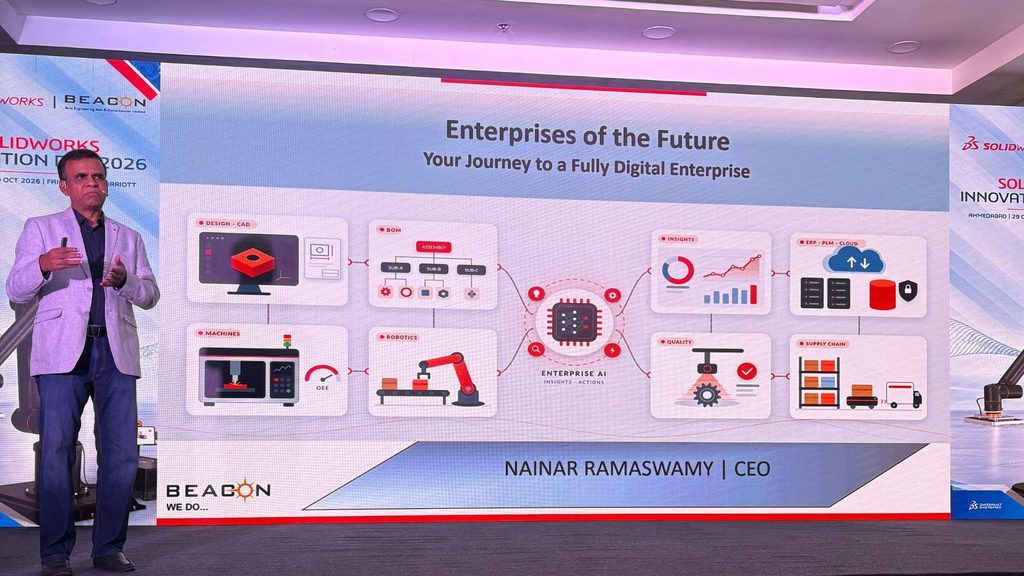
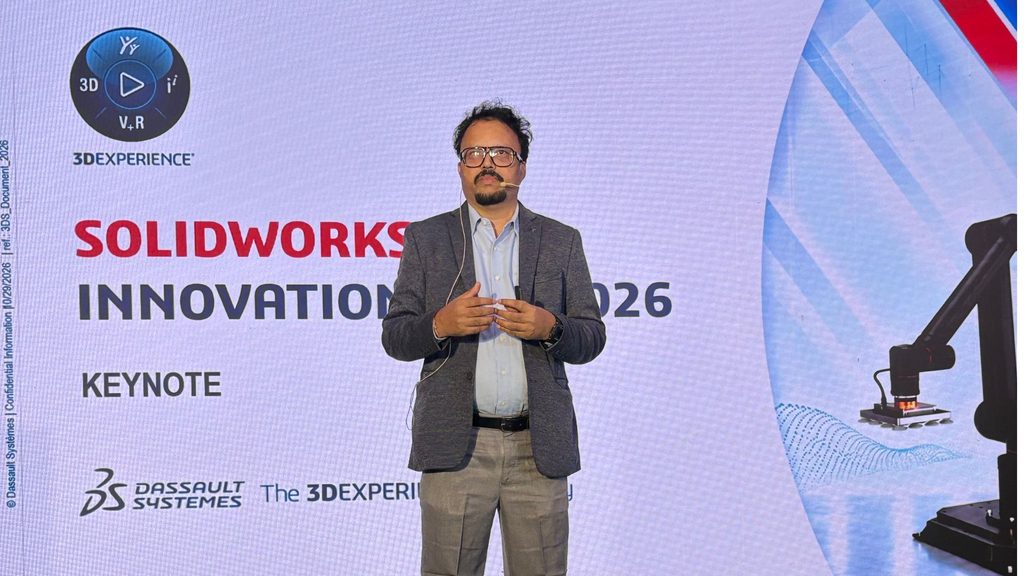
The event was led by Nainar Ramaswamy, CEO of BEACON, with Mahesh Biradar of Dassault Systèmes bringing the discussion toward the skills and mindset engineers will need as AI becomes part of their everyday work.
Engineering’s AI shift is becoming an enterprise conversation
Ramaswamy opened the event by positioning engineering within the wider digital enterprise. His perspective connected CAD and product development with manufacturing, quality, supply chains and enterprise systems, where information created during design can remain valuable throughout a product’s lifecycle.
That thinking returned in BEACON’s From Idea to Shopfloor discussion, which connected 3DEXPERIENCE, virtual twins, digital twins and DELMIAWorks to the wider challenge of maintaining continuity between engineering and production.
For manufacturing leaders, the distinction is important. Improving a designer’s productivity has limited value if the resulting information must still be recreated, manually transferred or reconciled when the product reaches manufacturing.
Biradar addressed the other side of that transformation during his session on developing a growth mindset in the age of AI, emphasizing the importance of continuous learning as engineering technologies evolve.
“The tools will keep changing. The people who keep learning will keep leading.”
His message captured an important reality behind the technology demonstrations. AI may reduce repetitive engineering work, but engineers still need to understand design intent, validate results and decide whether a proposed solution is appropriate for real-world production.
What’s new in SOLIDWORKS 2027 for engineers?
The practical value of SOLIDWORKS 2027 lies in reducing the manual work surrounding complex design, while introducing more intelligent assistance directly into engineering workflows.
Among the capabilities highlighted through the SOLIDWORKS 2027 enhancements are several developments relevant to design teams and manufacturers.
AI-assisted engineering with LEO: SOLIDWORKS’ AI companion can help identify assembly-performance bottlenecks, generate assembly instructions, create automation macros through natural-language prompts and assist with converting imported geometry into editable models.
Model Variability: Engineers can define product variants, optional features and numerical parameters within a structured configuration model. This is particularly relevant for manufacturers producing multiple versions of industrial equipment from a common design, where manually managing every variation can consume significant engineering time.
Smarter management of large designs: Improvements include in-context editing in Large Design Review mode, background processing for imported STEP and IGES files, and performance guidance for complex assemblies.
Manufacturing-ready modeling: Expanded sheet-metal functionality, including stamping on bend regions, and improved support for large color point-cloud datasets help engineers work with more complex geometry and manufacturing requirements.
These capabilities do not all represent newly introduced AI features. Some AI tools became available through the 2026 functional updates and are part of the wider SOLIDWORKS 2027 feature set. Together, they show how intelligent assistance is being introduced alongside conventional engineering improvements rather than replacing established design methods.
From product variants to physical production
The event’s discussions on automation made the implications more tangible.
During his DriveWorks session, Ketan Panchal explored how manufacturers can turn established engineering rules into repeatable design processes. Instead of rebuilding a similar product for each customer requirement, teams can use configured parameters and predefined logic to generate corresponding parts, assemblies and drawings.
That approach has particular relevance for industrial machinery and equipment manufacturers, where customised specifications often create repetitive design work.
The discussion continued through SOLIDWORKS Simulation, 3DEXPERIENCE and digital manufacturing technologies, before moving toward Formlabs 3D printing and CAMWorks. Each addresses a different stage of the process, from validating engineering decisions and preparing production information to prototyping and CNC machining.
What connects these technologies is the possibility of reducing the gaps between design, validation and manufacturing. For engineering teams, that could mean fewer disconnected handoffs and better access to product information as designs evolve.
The challenge is ensuring those systems work together reliably, particularly when manufacturers already operate different CAD, ERP, manufacturing and shop-floor systems.
What comes next for Industrial AI?
The direction presented in Ahmedabad points toward a future in which AI assists engineers across more of the product-development lifecycle, rather than remaining limited to isolated CAD commands.
The near-term opportunity is likely to be in repetitive, well-defined engineering tasks: generating documentation, configuring product variations, identifying assembly issues and helping teams retrieve or reuse existing engineering information.
Over time, greater integration between design, simulation and manufacturing systems could make it easier to assess the downstream impact of a design change before it reaches production.
That is an editorial outlook rather than a confirmed SOLIDWORKS product roadmap. Achieving it will depend on reliable engineering data, interoperability, validation standards and the willingness of manufacturers to adapt established workflows.
For CTOs, plant heads and engineering leaders, the commercial question will be whether these capabilities measurably reduce rework, improve design-to-production continuity and help teams deliver products more efficiently.
The SOLIDWORKS 2027 launch in Ahmedabad offered a view of how that transition is developing. AI is becoming more useful inside engineering software, while connected manufacturing technologies are extending the conversation beyond the design workstation.
The next competitive advantage in manufacturing may come not from generating designs faster, but from making the entire journey from engineering intent to physical production more connected, traceable and reliable